Tisha B’av 2026
A Short Story

“A voice is heard in Ramah, lamentation and bitter weeping.”
“There is hope for your future.”—Yirmiyahu 31:15, 17
Jerusalem, 70
Yehuda ben Shimon had been hungry long enough that hunger no longer felt new. It had settled behind his eyes and in the trembling of his hands, like an old friend.
He sat on the floor of the study house, scraping letters from a broken piece of pottery with the point of a knife. There was no reason to do it. The lessons had ended weeks ago. The teacher was dead. Half the benches had been burned for cooking fires.
Still, he scraped until the shard was clean.
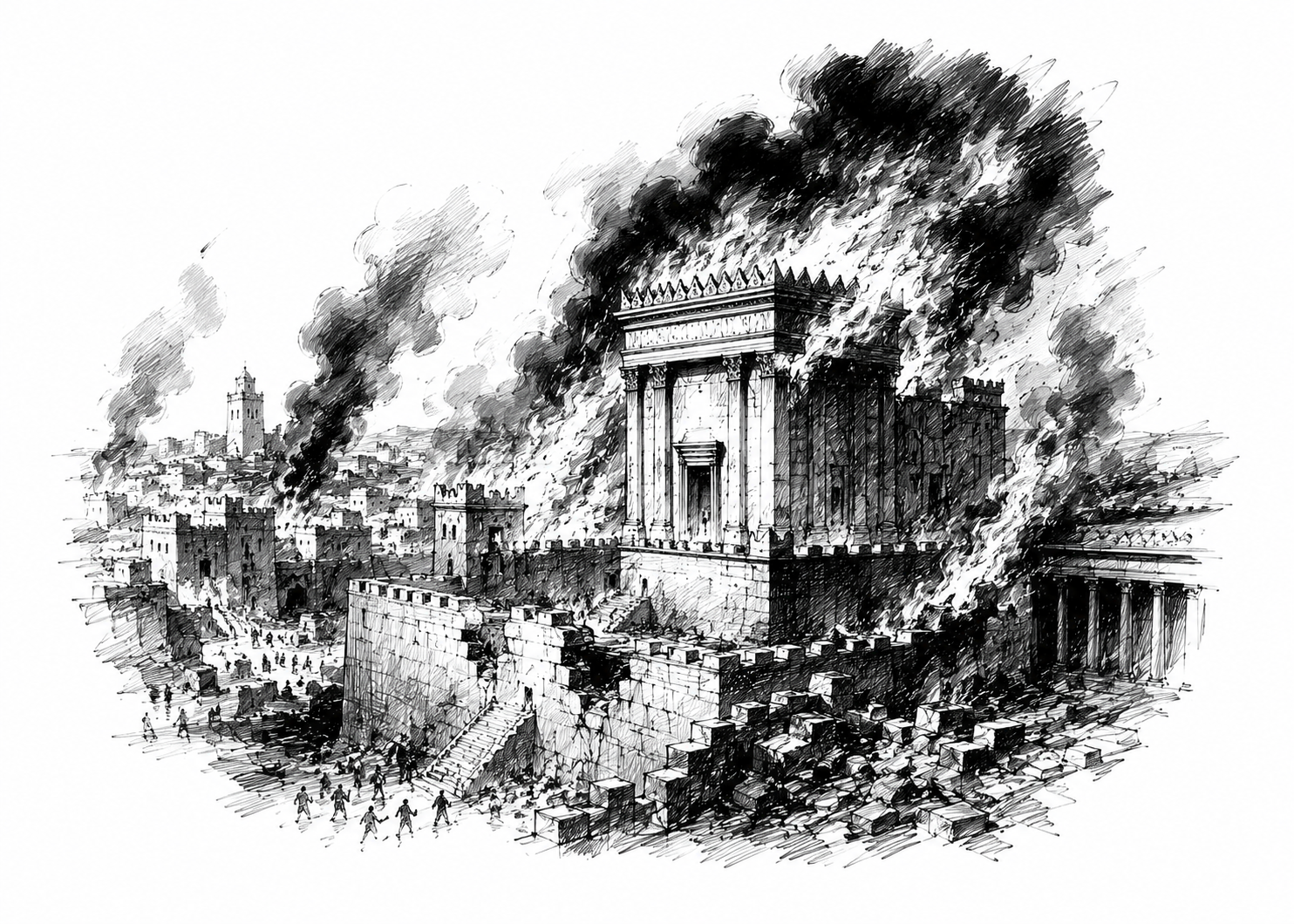
Outside, men ran toward the Har Habayis. Others ran away. Through the doorway Yehuda could see smoke rising above the roofs, black at the bottom and red where the sun caught it.
His sister Chana came in carrying her son.
“Natan cannot stay with me,” she said.
The boy was eight. His cheeks had narrowed. He held one sandal in his hand because the strap had broken.
Yehuda looked at his sister. She did not ask him to save her. She just pressed Natan’s hand into his.
They went downhill through alleys filled with stone, smashed jars, and bodies covered with mats. Near the old market, Yehuda lifted a paving slab. Beneath it ran a drainage channel toward the lower city. He had hidden there once during the fighting between the factions.
The channel was hot and nearly dry. They crawled while the city shook above them. Natan whispered that he had lost his sandal.
“Leave it,” Yehuda said.
Near the southern end, light entered through a break in the stones higher up on the wall. The opening was too small for Yehuda’s shoulders. Natan could pass.
Yehuda pushed him toward it. The boy stopped.
“What is my name?” Yehuda asked.
“Yehuda ben Shimon.”
“And yours?”
“Natan ben Elazar.”
Voices sounded behind them. Metal struck stone.
Yehuda put both hands beneath the boy’s feet and lifted. Natan caught the edge, kicked once against Yehuda’s shoulder, and disappeared into the light.
Yehuda sat beneath the opening. He was still looking up when the soldiers killed him.
Mainz, 1096
Someone was hammering on the gate of the bishop’s palace.
Yehuda ben Gershom sat with his back against the inner wall. Around him, the Jews of Mainz prayed, argued, wept, and sharpened kitchen knives against the stones. They had paid the bishop for protection. The bishop had fled.
The hammering stopped.
For a moment the courtyard was quiet enough to hear the horses in the stable.
Yehuda’s student, Shmuel, stood beside him. The boy was twelve and knew three tractates better than most grown men. Now his teeth clicked together.
The gate shook again.
Across the courtyard, a non-Jewish servant opened the stable door and beckoned. His name was Matthias. He had carried firewood to Yehuda’s house for years. Behind him was a loft reached by a ladder.
There was room above for one small body.
Yehuda walked Shmuel across the courtyard. No one stopped them. Every man was with his own wife, his own mother, and his own children now.
At the ladder Shmuel seized his sleeve.
“Come.”
Elazar looked at the opening. Then he looked back at the courtyard.
He handed Matthias his knife. The servant understood. He cut the hair close at Shmuel’s temples. The curls fell into the straw. Maybe if he was found, he could blend in. Maybe.
Shmuel began to cry without making a sound.
“You will grow them again,” he said.
Matthias pulled the boy into the loft and covered him with hay.
When the gate suddenly broke, Yehuda was still standing beneath the ladder. They killed him there. He did not look up.
Seville, 1481
By the time they came for Diego de Carmona, the oil in the Friday lamp had burned halfway down.
His wife had covered it with an earthen bowl, but the room still smelled of smoke. On the table lay bread, cold chickpeas, and a small fish cooked for shabbat. It was all they had left in the house.
The knocking came again.
Diego stood in the rear room with his account book open. It contained the names of patients who had trusted him with more than fever and childbirth. Beside each Christian name, in a script only he could read, was another name.
Beatriz was Rivka.
Fernando was Moshe.
Diego was Yosef ben Avraham.
His daughter Isabel watched him tear out the pages. She was fourteen. To the men outside she would be Isabel de Carmona. Her mother still whispered “Rachel” when waking her.
Diego held the pages over the lamp.
For one breath he could not release them. They were births, marriages, circumcisions performed in locked rooms. They were old women teaching girls to clean rice grain by grain before Pesach. They were men who had forgotten nearly every prayer but still turned toward Jerusalem twice a day.
The flame took the bottom edge.
He dropped the pages into a brass basin and stirred them until the writing folded into black flakes.
The door splintered.
Months later, in the prison at San Jorge, an inquisitor placed a clean sheet of paper before him.
“Write the names.”
Diego studied the feathered end of the quill. He thought of Isabel watching the pages burn. He thought of his mother saying "Yosef" only once, when no one else could hear.
He pushed the paper back.
On the morning they led him out with five others, bells sounded across Seville. Diego moved slowly because the chain between his ankles was short.
At the place of execution, a friar asked his name.
“Yosef ben Avraham,” he said.
The friar leaned closer, unable to hear him over the bells.
Diego said it again. Loud. The bells were still ringing when the smoke covered him.
Warsaw, 1943
Lejb Lewin carried the metal box beneath his coat.
It was not heavy. That troubled him. He had expected the record of a murdered city to weigh more.
At 34 Świętojerska Street, three men waited in the cellar. One held a candle. Another had removed bricks from the floor. Dust covered their hair and shoulders.
Lejb placed the box beside the hole.
Inside were reports, drawings, ration cards, notices torn from walls, and pages written by people already gone. Treblinka appeared again and again. So did ordinary things: the price of potatoes, a child’s joke, a complaint about a neighbor, the recipe for soup made from almost nothing.
Lejb reached into his pocket.
He had one more page. His sister had written it in school before the deportations. Twelve lines about their apartment on Nalewki Street. She had described the blue cup their father used each morning and the way their mother hummed when she was cooking. At the bottom she had signed her name with a flourish.
Chana Lewin, age eleven.
He put the page into the box.
The men lowered it into the earth and replaced the bricks. No one said Tehillim. There was work to finish before morning.
Lejb returned to the bunker where his mother waited. The next day, German troops entered the ghetto. Shots came from windows and rooftops. For several days the streets belonged to no one.
Then the burning began.
Smoke entered the bunker through the cracks. People soaked blankets and pressed them against the door. Lejb’s mother sat beside him, holding the blue cup from Nalewki Street. She had carried it through every move.
When the ceiling caught, Lejb took the cup from her and filled it from the last bucket. He gave her the water.
A beam fell between them.
His mother called his name from the other side. Lejb answered once, then again. When she called a third time, he did not answer.
Chicago, 2026. Tisha B’Av
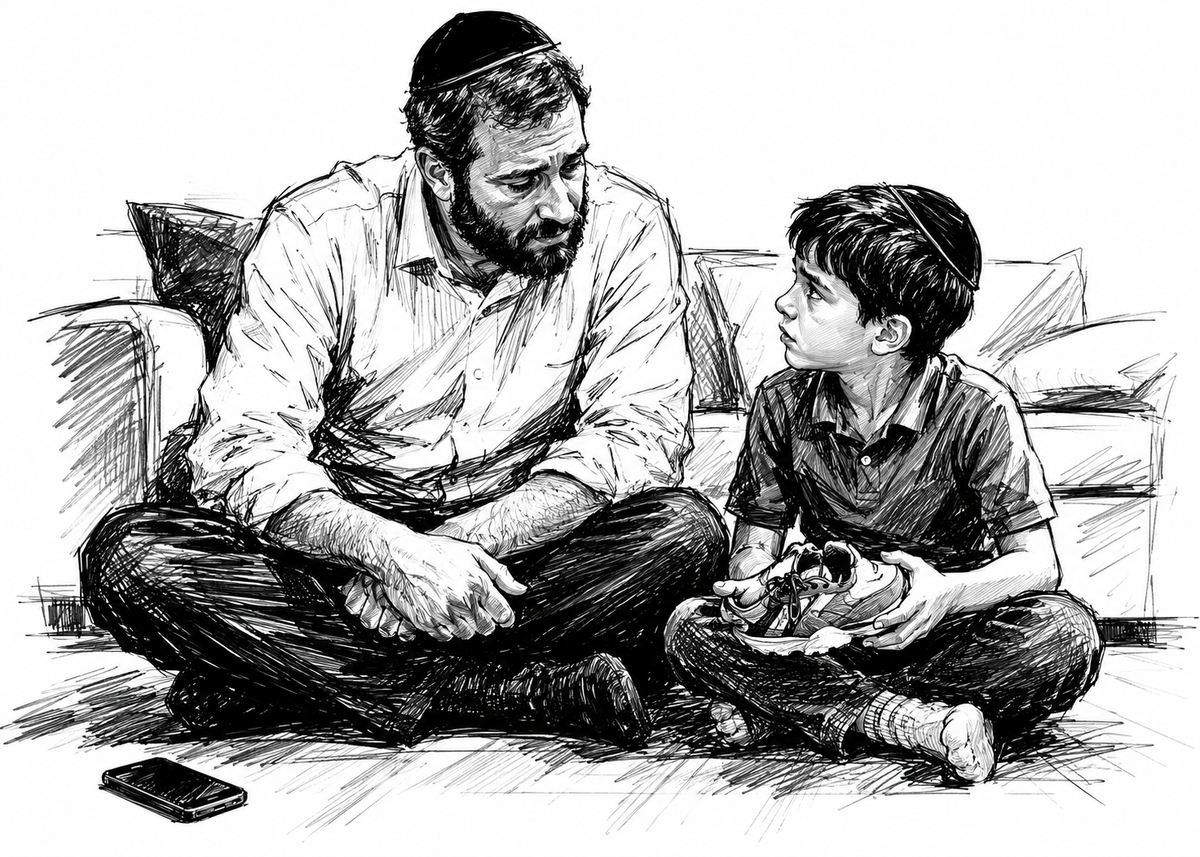
“Abba.”
Ari woke on the living room floor with his phone beneath his hand.
For several seconds he did not know why he was there. Then he saw the low folding stool, the unopened book of kinnos, and the gray afternoon light behind the blinds.
The air conditioner clicked on.
His youngest son, Yoni, stood over him holding a sneaker.
“Can you fix this?”
The lace had pulled through the torn eyelet. Ari turned the shoe over in his hands.
“Not now.”
Yoni remained there.
“When is later?”
“After the fast.”
The boy sat on the carpet. In the kitchen, one child opened the refrigerator and another shouted that he was not allowed. Ari called out without lifting his head. The refrigerator closed. A moment later it opened again.
His phone showed two work emails, a message from the mortgage broker, fourteen unread posts in the neighborhood WhatsApp group, and a news alert he had already forgotten by the time he cleared it.
He had gone to shul the night before. He had sat on the floor and listened to Eicha. In the morning he had made it halfway through the kinnos before the words began to pass through him without leaving anything behind.
“Why can’t we eat?” Yoni asked.
“Because it’s Tisha B’Av.”
“I know. Why?”
Ari worked the lace through a different hole.
“The Beis HaMikdash was destroyed.”
“What did it look like?”
Ari opened his mouth.
On the coffee table lay Yoni’s summer workbook. The last page was a family tree. Yoni had written his own name in the lowest box. Above it were Ari and Devorah. Above them, grandparents. The boxes higher up were empty.
Ari picked up the workbook.
“My teacher said we can call Bubby,” Yoni said.
Ari looked at the blank boxes. The room was cool. Outside, a truck backed into an alley, beeping at steady intervals. His phone lit again and went dark.
He set it facedown.
“There was a man in Jerusalem,” he said.
Yoni reached for the sneaker.
“What man?”
“His name was Yehuda ben Shimon.”
Ari sat up on the floor. Yoni curled up beside him, leaving the broken sneaker on the coffee table.
“He was hungry,” Ari said, “and the city was burning.”