Ki Seitzei: A Hero in General
A battle plan that actually works

You are a holy Yid. No? You would die for Hashem, for fellow Yidden. We all have questioned whether we could do it, and perhaps there are others who couldn’t rise to the challenge, but I trust you. I know you are the one who would die al kiddush Hashem.
But, not to make it awkward, do you live like this in your life? In all areas of your life? Every moment? Every glance the wrong way, or thought that flits across your mind? What about that time you could have been present with your young son while he tumbled through the living room, but you were too busy checking a status on your phone? You said you’d give up your life, but you wouldn’t even give up your phone for a single minute…
And no, I am not targeting just you. I do this too. I truly am the main character of my life, and I see myself as the good guy. I would die for my family and my community. But I know the little things. The little things in my life I let slip. The human things.
The Noam Elimelech teaches us from this week’s parsha that “There are people who, in the generality of their limbs, sacrifice themselves for Hashem through fasting, deprivation, and the like. But in particular, each individual limb by itself is not as proper and correct as it should be. At times they stumble through them, through some seeing or sustained looking, through speech, or through other matters that a person tramples beneath his heels.”
Yes. You thought we already went through that bit of Torah way back in Parshas Eikev, when you were reminded again of the vort that you must treat every mitzvah with reverence, even the small ones.
The Rebbe Reb Meilech brings a Chazal from Yoma: “אֵבָרִים שֶׁפָּקְעוּ מֵעַל גַּבֵּי הַמִּזְבֵּחַ, קוֹדֶם חֲצוֹת — יַחְזִיר”—“With regard to limbs from offerings that were forced off the altar by the heat of the fire, if they fell before midnight, these limbs remain sacred. He should return them to the fire.”
“Individual limbs spring away and cause failure in a person who sacrifices himself to Hashem. ‘He must return’ means that he must return and repair them, sanctifying each individual limb by itself.”
We are the korban. We were always the korban. And we throw ourselves onto the fire for Hashem. It is honorable and worthy. But it doesn’t always mean we are totally worked out. There are parts of ourselves that need care. The little areas that need work. The mitzvos kalos that we trample underfoot.
I was taught in school that we all have a tachlis in life, a purpose. But we’re not born with a manual. We don’t know what our tachlis is. We have the Torah, but we need to walk its paths to find our tachlis. So it is easy to think that we need to be gedolim. Or massive askanim or massive gevirim. Those are grand poobah purposes. You can dream of the glory, of the greatness, of that purpose. But it’s too big, too general.
A rebbi of mine once joked that the minute a bachur comes off the plane home for bein hazmanim, he has made plans to finish all of Shas. But by the time bein hazmanim is over and he is planning to return, he’s barely done a single daf. Oftentimes the grand plan doesn’t include the details that are integral to a true avodas Hashem program. That’s where you start.
The Nesivos Shalom teaches on the Mishnah in Pirkei Avos that the way to learn what our tachlis is in this world is simple. It’s Torah, avodah, and gemilus chasadim. I hated that answer when I first heard it. It’s too… cliché. And not enough direction to actually work on a purpose.
But that’s it. The idea is not to create grand schemes. Yes, you are willing to die for Torah and for Hashem, but how do you get your whole being there? The answer is the small details. When you learn Torah and daven and help those around you, you will start to see things emerge that are your things. Small things. Coming one minute early to davening. Maybe it’s just coming on time to Borchu.
I have a friend who started working on himself only later in life. He is a huge inspiration to me. He does what many forget. And that is to pick one small and easy thing and do that. And then grow from there.
The yetzer hara likes big schemes, but growth comes in the small steps. He likes to make the project so astronomically huge. Because it feels good when it’s big. Go big or go home, as they say. And I say go home. Take a deep breath and spend ten minutes with your kid, phone-free. Don’t let yourself fall into the trap of “going big.”
And this is available to anyone at any stage. No matter where you are in life, you can always take a minute and choose something small. Maybe even impossibly easy, and commit to it. And when you pile these little things up over time, it’s a big thing.
And your korban will have fewer parts spring out of the fire. Maybe your korban is smaller, but it’s more whole, entirely for Hashem. This is what a Gibor is. The goal is to be kovesh the yetzer. Not to make grand plans and never follow through, but to find the thing that actually works.
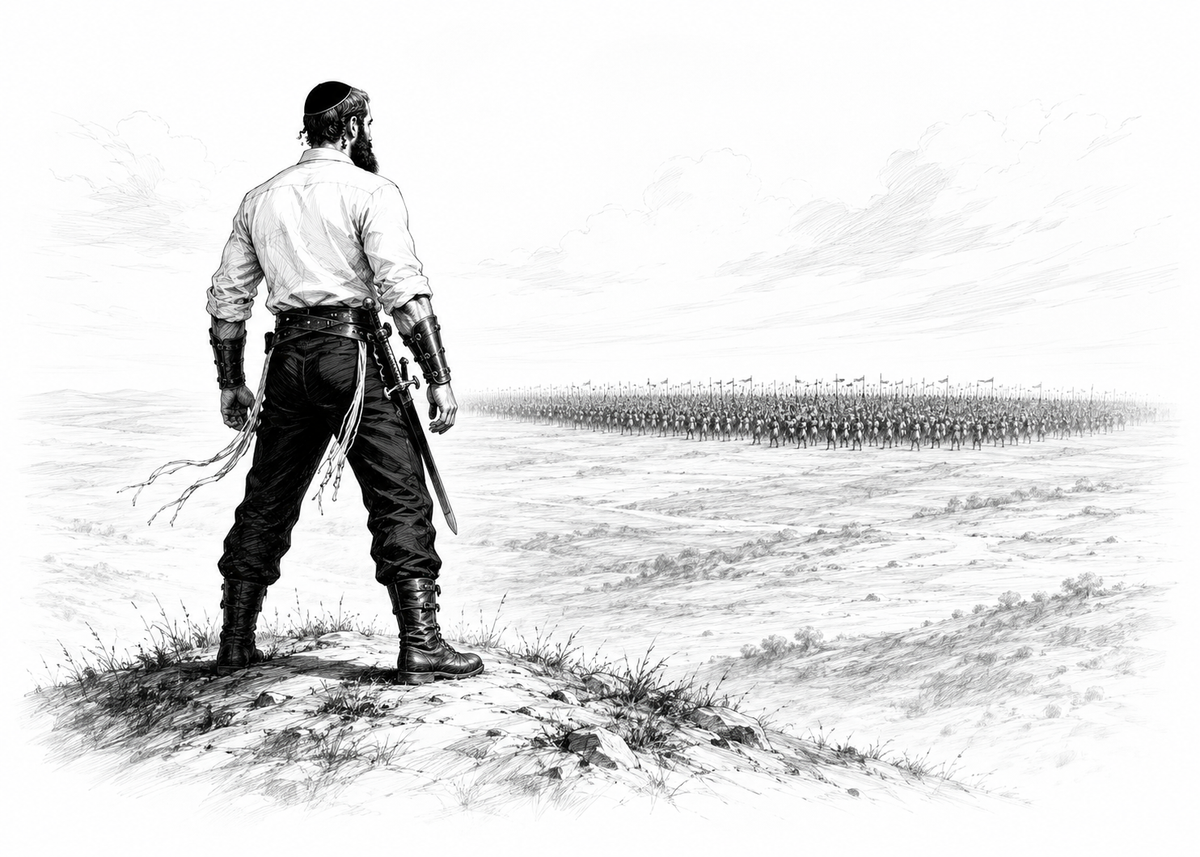
כִּי־תֵצֵא לַמִּלְחָמָה עַל־אֹיְבֶיךָ, when you go out to war with your yetzer, don’t be the hero in general. Don’t just dream of the cape flowing behind you. Choose the better battle strategy. Choose the path that slowly ties all the disparate parts of you together. The small things, the ones you can win day in and day out.
Brother, I look forward to seeing you out on the field of battle.