Vaeschanan: Comfort Me, Comfort Me
Who is left who will comfort me...?

“It is like a king who had a vineyard. Enemies entered it and cut it down. Who needs consolation—the vineyard or the owner of the vineyard? So the Holy One, blessed be He, said: ‘Israel is My vineyard, for the vineyard of Hashem of Hosts is the House of Israel.’
It is like a king who had a flock. Wolves entered it and tore it apart. Who needs consolation—the flock or the owner of the flock? Thus, ‘Comfort, comfort My people’—‘Comfort Me, comfort Me, My people.’”
—Pesikta Chadasha, §97
I return to my farm, or what is left of it, after having been away. I had to be away, but I was never truly away. I am always watching and managing things behind the scenes, but I return to see the devastation.
I walk slowly down the path from the road. The sun, slowly setting behind the trees, casting orange and pink hues across the meadow where my farm lay. As I grow closer to the entrance of the farm, I see the first glimpse of the place I called home. From this distance it looks like it always did. The farmhouse is sitting serenely up against the copse of large oak trees. The wide expanse of land behind where the wheat and barley grew. The rolling hills behind there are where my sheep would graze. From this distance it looked as it always did. But I was not fooled. I knew what had happened here. I was here for every heart-wrenching moment. Tears begin to flow freely down my face; the images of carnage sweep across my vision.
As I walked closer, the signs of destruction came into full view.
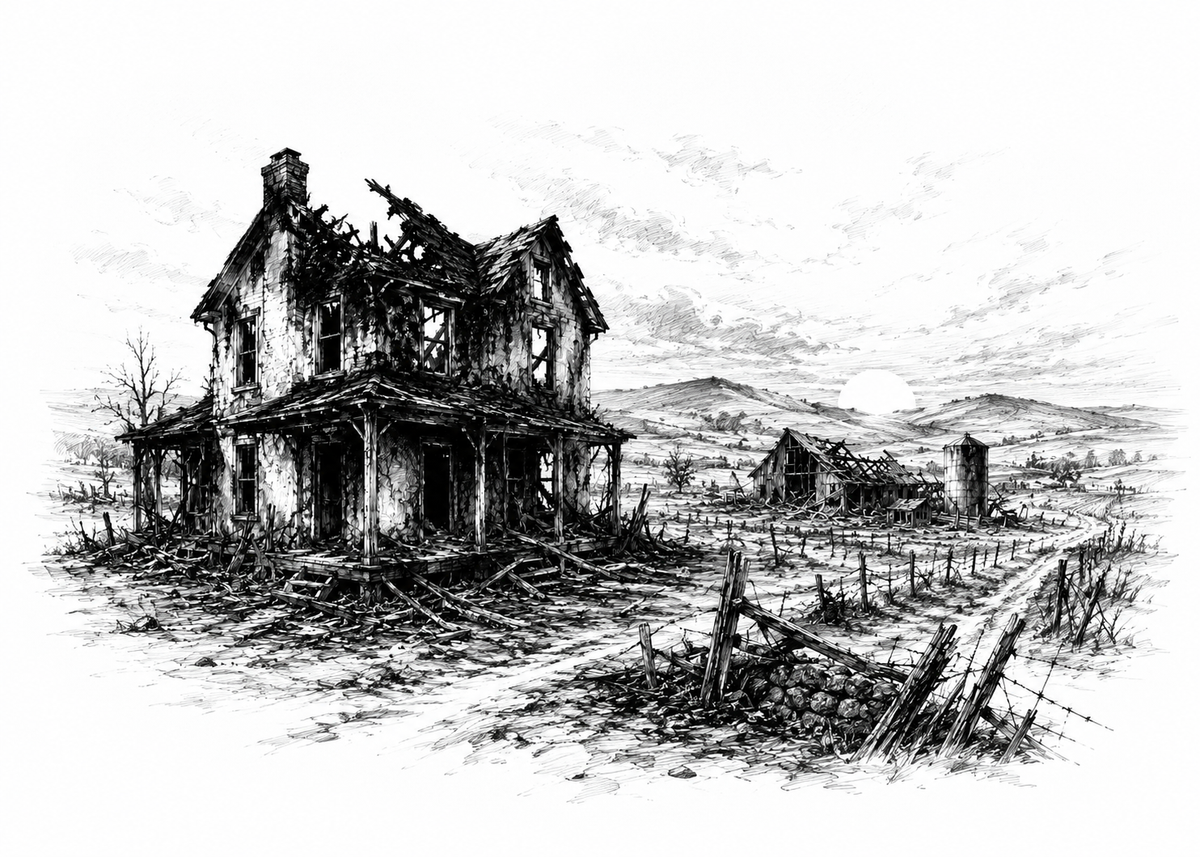
I reach the low gate at the border of the farm. The one that was built by my friend Nik. It hung lop-sided off its hinge, scarred and burned edges, truly nothing left but a few shards of wood and the sign slashed and charred sitting off to the side.
The front facade of the house is still erect, but as I walk alongside its southern side, the gaping holes of burnt masonry and charred timber appear. Looking at the house from the side, it seems as though a huge fiery hand had descended and gouged out a portion of the house in one scoop, leaving the eastern front facade intact but standing as a lie and a cover for the destruction that lay behind. At the very back, the western side where the bedroom was, only a charred and empty mess remains.
I walk to the pens on the northern side. I suddenly remember the one ram who constantly broke through the low walls there. I tried to reinforce the walls and then had to sometimes leave him locked away in the barn. He would get so rowdy and rile the others up. But he is gone now. I look around and see where one of the ewes used to sit and sing to her young. The sad memories of her neglecting her duty one season when her young wouldn’t latch right, but I still loved her and the ram and all the sheep, the good ones and the bad ones; now they were gone. The remnant spread across the valley at different farms, waiting to return when everything gets fixed and repaired.
Beyond the pens, where the field once thrived, I remember waving in the breeze the golden carpet of wheat, whispering, constantly whispering, words of wisdom and love to me and to all who lived here. The barley fields that called to man and animal alike. Who sustained my children and their flock through the good times and the bad. Now the field lay barren and empty. Nothing grows there any longer, and the sight of it pulls whatever tears I have left from my reddened eyes.
I keep walking. Towards the vineyard in the south. The roots and rows of black, twisted vines. I remember the years of the sweetest wines and even the years when the vines grew stubborn and refused their yield. But they were my vines, and I loved them dearly. A remnant was saved, also waiting to return.
The sobs came from my throat unbidden now. Looking at the desolation always brings me to this sad state.
As I walked the rolling hills behind the now barren wheat fields, I thought about what I could have done better. The attack came so swiftly. The blight that entered first and destroyed the crops and then the wolves from the west who descended on my flocks and killed so many.
What could I have done? I tried to help; I tried to stop it. But it was to no avail. I brought experts in. They showed how to bolster the fences and to plant in the correct areas with the right soil, but the advice was not heeded.
“But I could have been better," I said to myself. My voice cracked in the hoarse wails that left my throat.
"Oh, my children who once lived here, where have you gone? I sent you away, and you have paid double for your sins.”
“My children who lived on this farm with the flock and the vineyard and the wheat and the barley and the love and the hardships and the pain and the joy and the sorrow are all torn from this place.”
“One day. One day they will all return here. One day the fields will whisper their words of wisdom and love to me again. One day soon, my children, soon.” I shout to the sky and to the sun and to the moon and to all who would listen.
But for now I walk this land. And this sorrow and this pain my children feel every moment they are away are mine to bear as well. I walk this land every day. I have been here since that hateful day when the attack came and banished my children and my flock and my vineyard from this land. And every day I cry again.
Who will comfort me? Who will comfort me?