Yom Kippur: Facing the Brokenness
When it feels like you don't deserve to climb out of your abyss

try to protect myself. No one wants to put themselves in danger willingly. We all want to be safe and secure. So I learned to navigate life. The things I know are harmful, I try to stay away from; the things that I know are good for me, I embrace.
There are even things I want to do, but I learned how to refrain from doing them, to war-game the scenarios of what could happen if I did X, Y, or Z. And I am grateful that I had the education I had so that I could know about those pitfalls that sneak up on you, that come dressed in justifications but are really hollow and rotted from the inside.
Many times in my life, I have stayed away, and I know that aside from the reward I will receive in Heaven when all the accounts get tallied up and squared away, the restraint I showed in this life will help me strengthen my own discipline and growth and continue to get better at this thing called life.
Each moment of forward movement propels me toward a life where I can feel worthy of being a shaliach of Hashem in this world. Every mitzvah and good deed and every moment I hold back is fuel for the fire, shaping me and crafting the person Hashem wants me to be. It also feels good to just do it.
The world today has engineered a culture of distractions. A culture that demands fealty and worship to the abyss of fleeting, vapid pleasures. Resisting the urge is a rebellion against the darkness. It is an honor to hold the flag of Torah in a world that would rather see it burned, to stay in the fight and take blow after blow, wounds dripping and flowing with blood, no matter what is thrown at me.
But what about those times when I fall into the abyss? As long as I held tight to my mission, even if not perfectly, I could claim I was still growing, that I didn’t fail. The world recognizes the wounded soldier, bent on one knee, struggling to stand.
But actual failure. Descent into oblivion... the world holds no banner for such men. The education of my youth told me to stay upright, to feel honor for the small wins. But there is no message of hope for the one who has fallen. At least, as far as I had been taught in my youth.
Teshuvah can bring a man back from the edge, but I used to think that only applied to the soldier still in the fight. But if I had fallen through the floor of what is right and wrong, do I dare try to stand again? Will teshuvah really work? Can I return to a place of honor and meaning and self-worth? I failed. How do I return after a complete failure? How dare I return with the blood from the knife I used to hurt another still caked on the blade and my hands?
The yetzer hara can exert such great forces upon me that, in the moment, I feel as if I have lost my free will. And the moment after the collapse, the truth rises up and boots me with the clarity of a thousand-megaton nuclear bomb. The truth of my actions weighs me down with a heaviness that not even Gehinnom could mimic. Maybe that’s really what Gehinnom is. The truth of the matter. And in this crushing state, can I really ever return? My mind screams at the foolishness of believing there is any hope of returning. Can I face the world after a fall? Can I face Hashem? Can I face myself?
All the successes of my past come to me as accusing angels. “How can a man who fought the great hordes of evil succumb?” Oh, how I torture myself with the good I have done. Is there no respite for one such as me?
Rav Tzadok HaKohen spoke of this war inside me. This war between the one who resists and the one who fails. He told me that sometimes I am like Yosef, וַיַּעֲזֹב בִּגְדוֹ בְיָדָהּ וַיָּנָס וַיֵּצֵא הַחוּצָה “He left his garment in her hand, fled, and went outside.”
There are times I have resisted it all and run, even at the last moment of temptation. I have tasted that strength before. When the bones of Yosef approach the sea, the waters flee from before him. All the draws of the physical world are driven back.
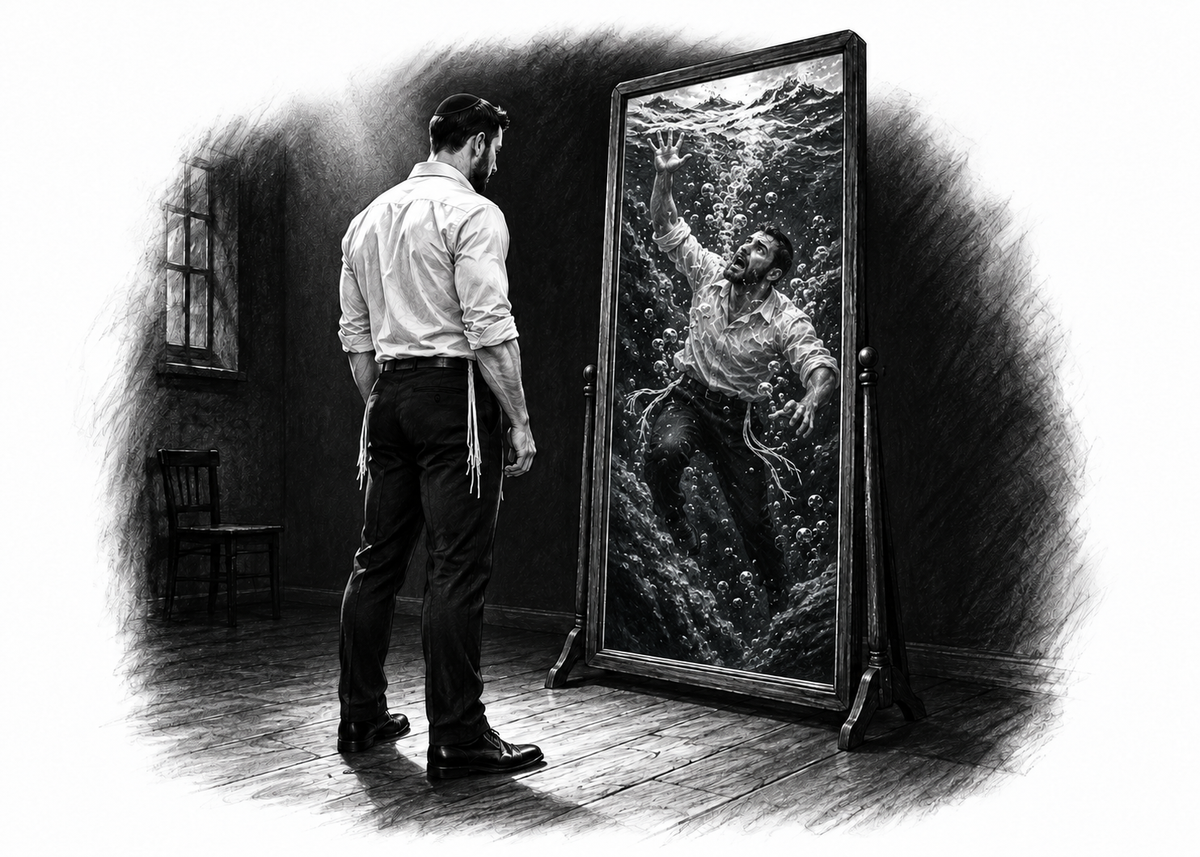
Other times, I do not run from the house of Potiphar, and it is easy to lose myself in the shame and the drowning guilt and forget that it does not need to be how I identify myself.
The Pri Tzadik says that in those moments, I must be like Yehudah, who said, צָדְקָה מִמֶּנִּי, “She is more righteous than I.”
Yosef was able to resist and flee the disaster. Yehudah refused to flee. He should have been crushed completely by his shame. But the Gemara in Sotah tells us that he forced himself to face his failure, to own it and recognize it for what it was, and in the owning of the failure, he sanctified Hashem’s name. And David HaMelech was born. Mashiach was born.
I always thought that teshuvah was about working with what you have and fixing what you can. Focusing on the unbroken parts. But that doesn’t work when everything feels broken. Yehudah teaches us that the brokenness itself is the teshuvah when we dare face it. Rav Tzadok teaches us that the light of redemption is born when I face myself. Even in the abyss itself.
He continues and says that Erev Yom Kippur, the ninth day of Tishrei, is for Yosef and Yesod, the ninth sefirah. It is the day we celebrate as if it were Yom Kippur itself, but it is the day when we have not yet been engulfed in failure. It is the day that is still about turning away before it is too late. Yom Kippur itself is David HaMelech and Malchus. It is the day we face ourselves, even those of us who are wallowing in our own darkness.
The waters flee from Yosef. Yet Nachshon, the nasi of Yehudah, has already jumped in because Yehudah overcomes his fear of the abyss and faces the darkness with a courage that comes from the deepest part of our being. Rav Tzadok HaKohen brings the pasuk in Tehillim, הוֹשִׁיעֵנִי אֱלֹהִים כִּי בָאוּ מַיִם עַד נָפֶשׁ, “Save me, Hashem, for the waters have reached my soul.”
And on the day of Yom Kippur itself, the tenth day of Tishrei, we learn what Malchus means: that even under the crushing weight, we still must face ourselves and own it.
That is how we can fulfill the promise of Hashem on Yom Kippur, כִּי בַיּוֹם הַזֶּה יְכַפֵּר עֲלֵיכֶם לְטַהֵר אֶתְכֶם... לִפְנֵי ה׳ תִּטְהָרוּ “For on this day atonement shall be made for you, to purify you... before Hashem you shall be purified.”
In truth, both men are me. I have in me the power to resist, and the “waters flee” from before me. And I also have within me the power to face what I am, even in the most broken of states. Facing it with every scrap of courage I have left in me is also being mekadesh Shem Shamayim in the highest of ways.
And the point is not for me to be broken, but to look to Hashem anyway, even in my brokenness.