Shemini Atzeres: Hashem Wants Me at the Table
The Emunah while standing below, where pain still looks like pain

My father, of blessed memory, was very sick at this point. He was in palliative care. It was just a matter of time. Someone came to visit. A friend from the community. A nice guy. Learned. He had the title “Rabbi” in front of his name but wasn’t in a position at the time.
He was in genuine pain and felt for my father. He was genuine and truly did his best to be present with him in the hospital room. And then he said, “It should be a kapparah.”
It was a slap in the face. It was so inappropriate for the moment, assuming my father wasn’t already completely clean of all sin. We were at the end of this battle already, and my father had gone through all the levels of grief. He was at acceptance. He was a malach on the hospital bed. And he smiled at his friend, who was not particularly close, more like an acquaintance from the community. He made him feel good and was grateful for the visit.
I never asked my father what he thought of that comment. “It should be a kapparah.” My father would have probably just smiled and said he was a Yid, and it didn’t matter what he said.
I still carry it with me. This comment. It’s not a one-off comment. It’s said often in times of trouble or crisis. Usually not when the pain is close at hand. Often, it is said by someone who is not in pain themselves but is talking with another who is going through the wringer.
It’s like a filler sentence, like saying “um” when you are trying to think of the next word to say, or when there’s a lull in the conversation and you say, “So... uh... know any good jokes?”
It feels like the wrong thing to say because it is the wrong thing to say while a person is in the midst of his crisis. But it does come from a kernel of truth: that in each painful experience, there is light, Godly light, to be gleaned. Yet it falls so flat when I’m the one in the crisis. I can’t hear this truth.
Anytime the subject of pain and suffering is talked about from the pulpit, from a sefer, or through this newfangled podcasting trend, the lesson is to see the light that’s buried in the pain. And, of course, it’s true. It’s 100% true!!! But when I’m in it, sometimes the pain is too deep, and I can’t see the light.
Is this where Jewish guilt comes from? Maybe a part of it? That when bad things happen, I add to my misery the guilt of not appreciating the deep lesson hidden inside. And so I suffer on both counts. I am not only suffering, but I am judging myself for suffering.
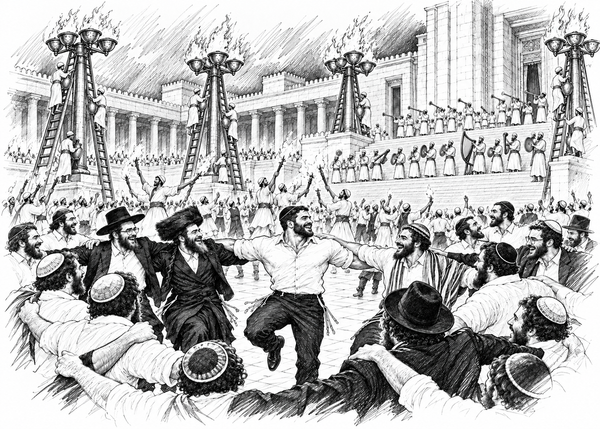
Maybe this is not the best topic to launch into a thought about Shemini Atzeres, but it’s what I’ve got for the moment. On Shemini Atzeres, in the Beis Hamikdash, we brought only one bull and one ram for the day. The entire Yom Tov beforehand had animal after animal packed into the courtyard. Maybe, like contemporary families after a whole week of Chol Hamoed trips, everyone just needed a break from the chaos.
The question is a famous one, and the Midrash Tanchuma gives us the famous answer: that after the large seven-day feast with the king, he asks his beloved to stay behind and have a little meal together. Just the king and his beloved. נְגַלְגֵּל אֲנִי וְאַתָּה בְּמַה שֶּׁתִּמְצָא, בְּלִיטְרָא שֶׁל בָּשָׂר אוֹ לִיטְרָא שֶׁל דָּג אוֹ יָרָק. “Let you and me make do with whatever can be found: a measure of meat, a measure of fish, or some vegetables.”
This lashon of נְגַלְגֵּל is wild. We will make do. In a world where the esrog must be perfect, the matzos shalem, the halacha clearly delineated, Hashem says we will make do. The Piaseczna Rebbe focuses on this word. To make do.
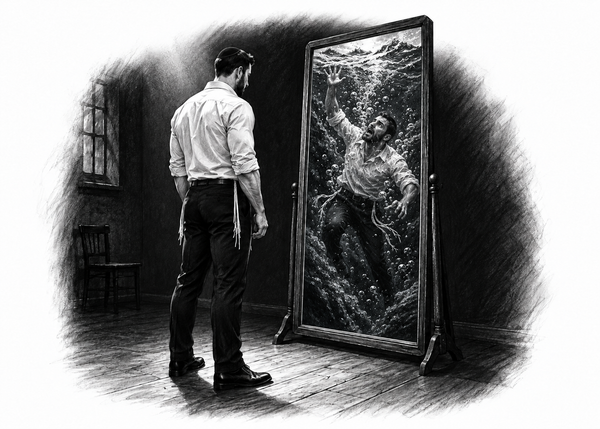
Then the Rebbe goes on to say the same vort that got me rolling at the beginning. The Nevi’im were like watchmen from on high, and looking down on the struggle of Klal Yisrael, they were able to see the truth that Hashem is there in the pain and in the darkness. And while this is a good vort, it doesn’t help me when I’m at my worst. I can’t see the light when I am at the bottom of the pit. It’s nice that there are the greats who can look down and marvel at the hidden light, but I can’t see it. It’s almost meaningless to me. But as I kept learning the Torah, he said exactly what I was thinking: “It was only because the prophets looked upon the suffering of Yisrael like watchmen looking down from above that they perceived the greatness of the light within it. But someone looking from below, who sees only the suffering, finds it difficult to see the light contained within it.”
The Rebbe saw me in my struggle. From high on the tower, above the fray, it’s possible to see the hidden light, the reason, the lesson. But when I’m below, the Rebbe agreed that it’s very difficult to see. And in that line, the Piaseczna Rebbe truly saw me.
The Rebbe taught this Torah in the Warsaw Ghetto, in the darkest pain of our history. He wrote words that no one else could ever utter but one such as he: “In truth, it is astonishing that the world continues to exist after so many screams such as these.” And regarding the innocents who were mercilessly killed: כְּאִלּוּ לֹא נָגַע הַדָּבָר חַס וְשָׁלוֹם, “As though the matter had not touched Him, God forbid.”
Yet he continues in his Torah for Shemini Atzeres and says, “On Shemini Atzeres, which represents the great union of Yisrael with HaKadosh Baruch Hu... know that Hashem unites Himself with Yisrael not only when things are good for you, but also during a time of constriction.”
Emunah and Bitachon do not mean I must always see the inner lesson of the struggle. They do not mean that I must become as those who stand in the tower, separated from the pain, look down, and see that it’s all for the best. If you can do that, it’s a very high level. But if you can’t, if you can’t see through the darkness, there is still a place for you at the table.
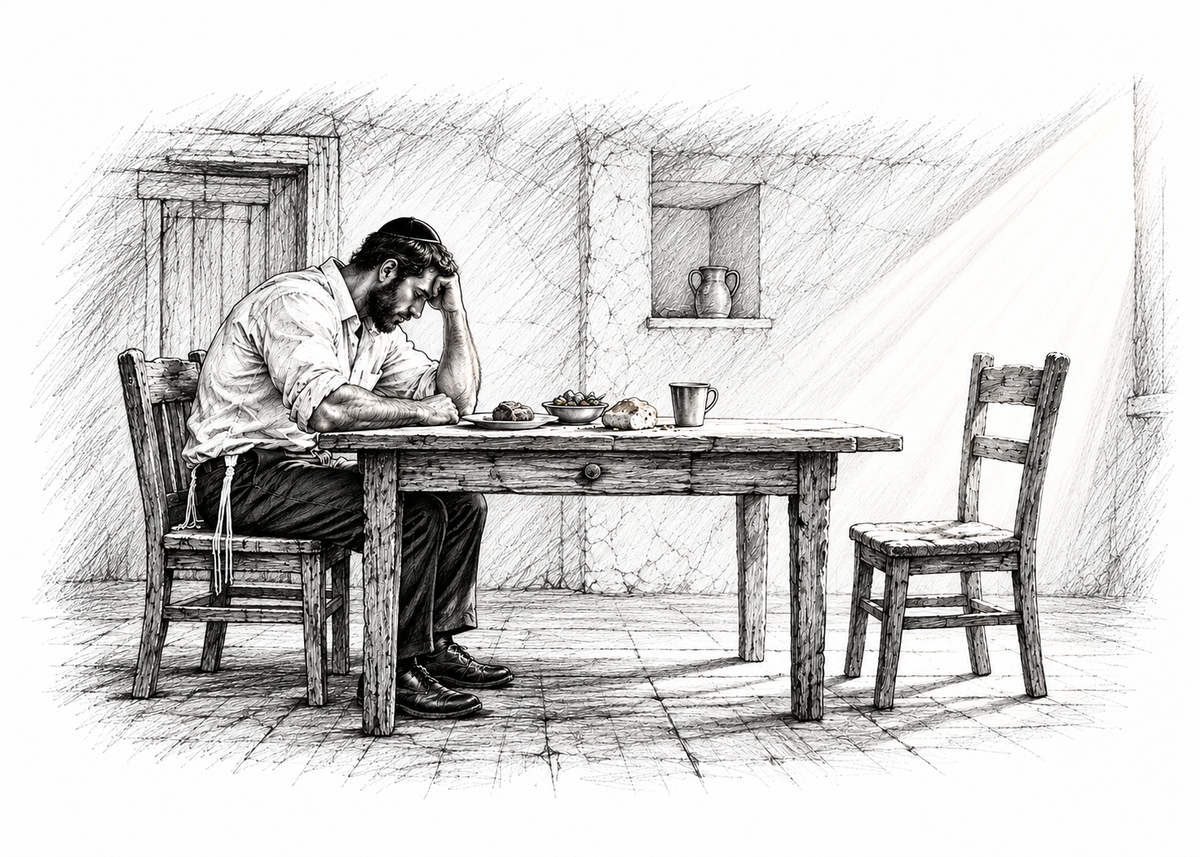
And know that even when it’s hard to see Him, He still wants to make a meal with His beloved. Even if I need to make do and all I have is a little leftover meat and some vegetables. Even if all I have is a few feeble words to say, I can still be here and talk with Him.
Hashem is not expecting me to always see the light that is hidden in the pain. He is there with me anyway. He loves me and cares for me even when I’m too lost to see Him back.
Even when I barely have anything to put out on the table.
Hashem is still there, sitting across from me.