Matos-Masei: Watch Your Mouth
The danger is not just forbidden speech.

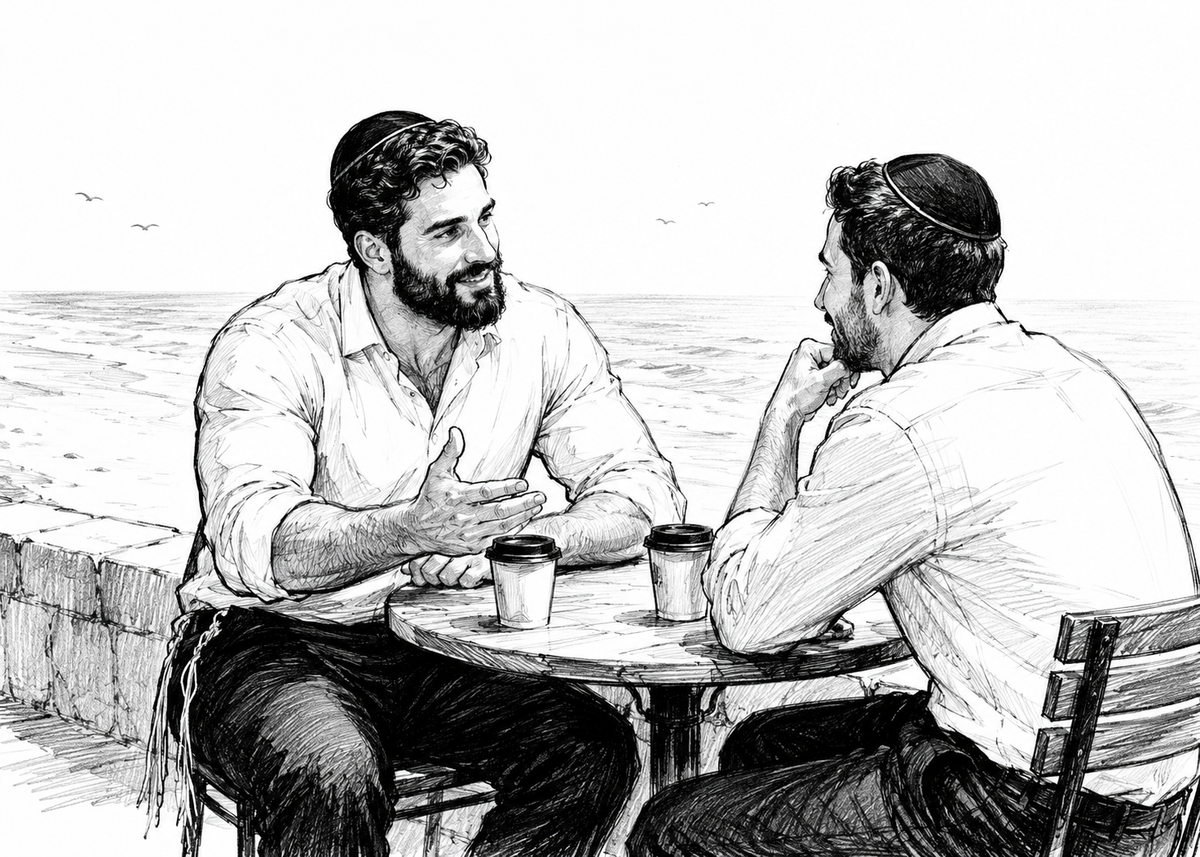
I have sat across frum men in suits, men with families, who give tzedakah, who know how to speak in Torah and heard them use four-letter words like they were nothing.
They weren't trying to be edgy, or rather, too edgy.
Just normal edgy.
A bomb dropped into a sentence because that is how people talk now.
A sharp little blast to make a point.
It's really just a lazy hammer.
A way to sound serious without having to know how to communicate well.
These days the one who does not use those words can feel like the odd one out.
Like he is too sheltered.
Like he is refusing to join the chevra.
A man thinks he knows which words are the dangerous ones.
Lashon hara. Lies. Vulgarity. Rage.
The words of poison when they leave the mouth.
Everyone knows poison kills.
But the Noam Elimelech reveals something deeper.
Regular speech, or the speech that feels normal, can be the trap.
Even beyond the cussing, there is also the endless small talk of banalities.
Small talk is not that bad if it's used to grease the stilted gears of conversation, but it needs to grow to carry the conversation to more holy heights.
The endless sports analysis.
The endless politics, which is just sports for angry adults.
Two teams in red and blue jerseys, each side chanting its own righteousness like drunk fans in the cheap seats.
The idea is it's easy to lose yourself into speech that feels fine, but, like an oozing pit of quicksand, will suck you right in.
In Parshas Matos, the pasuk states “ככל היוצא מפיו יעשה.”, Whatever comes out of his mouth, he must fulfill.
Based on this, the Rebbe Reb Meilech explains the tefillah we say before Shemoneh Esrei: ה׳ שפתי תפתח ופי יגיד תהלתך.
Hashem opens the lips, and the mouth draws speech upward into the world called Tehillah.
Holy words do not simply leave the mouth and disappear. They rise and attach to the highest heights of the olamos.
Not so with דברי הגשמיות.
Mundane words are נפסקים, cut off.
They leave the mouth and fall away.
That is the problem.
Not that every plain word is assur.
You don’t need to walk around sounding like a sefer at all times.
Very few people can live like that and still come off as legit.
The problem is that mundane speech needs to be lifted.
Shlomo HaMelech says in Misheli,” מות וחיים ביד לשון”, “Death and life are in the hand of the tongue.”
The Rambam teaches us in Hilchos Deos that a person should train himself in silence.
He is not talking only about lashon hara.
He is saying that even permitted speech one to guard it.
Our modern world has such a hard time with this.
We live in a generation where everyone is always saying something.
Posting. Commenting. Texting. Reacting. Explaining. Defending. Performing. Announcing. Branding. Processing out loud.
Telling the world their truth.
We make so much noise and call it authenticity.
And you may say, “What? I didn’t say anything wrong.” or "Those words aren't that bad, relax.”
Maybe not.
Maybe it’s not wrong.
Maybe it’s just dead.
That is what bothers me about the easy curse word.
It's not only the question of issur, though a Yid should ask that too.
But even before the technical aspect, you have outsourced your emphasis to crude and crass words.
You want the impact without craftsmanship.
Instead of searching for the right word, you grab the loud one.
Instead of building your sentences, you throw a brick through the window.
The Tanya in Perek Mem says that when you speak using your nefesh habahamis, if you speak in holiness to connect with Torah or even regular schmoozing that is mekadesh shem shamayim, you are revealing your true divine soul.
But when you speak idle words, the divine holiness within them becomes concealed.
The words may not be forbidden.
But they thicken the barriers over the neshamah and make the inner you harder to reach.
That is the danger of idle, crass speech.
In the Iggeres HaGra, the Vilna Gaon writes that a person is judged for everything he says, “even the slightest expression,” and he urges training oneself in silence.
He brings the Chazal that man’s pursuit in this world should be silence and then says one must seal his lips like two millstones.
He explains that idle words are powerful weapons that reach from one end of the world to the other.
So, for us, should we never speak?
No. A Gibor does not become mute.
A Gibor is not afraid of speech.
He knows speech is one of the great powers of man.
Hashem created the world with speech.
The Torah is given over in words.
Tefillah is words.
A father blesses his children with words.
A husband repairs and strengthens Shalom Bayis with words.
A leader supports his community with words.
Not every conversation needs to be deep.
A man can talk about food with kedusha.
He can talk about work with kedusha.
He can talk about sports or politics with kedusha if it is done sparingly and does not become his second religion.
He can make a joke with kedusha.
He can tell his kid to put on his shoes with kedusha.
He can discuss money, logistics, repairs, dinner, schedules, the car, the bank, the dentist, the broken sink, and the whole annoying machinery of life without letting his mouth become hefker.
It's easy to get tripped up.
It's easy to rely on four-letter words or the politics of the day.
Because then you don't have to think too hard.
You don't need to learn the language or efficient communication.
Just listen to Ben Shapiro and drop a few word bombs, and you get noticed.
But that's cheap.
You are bigger than that, brother.
Watch your mouth.