Bereishis: Hashem Is Not Finished with Me
…About the Man I Thought I Was Stuck Being

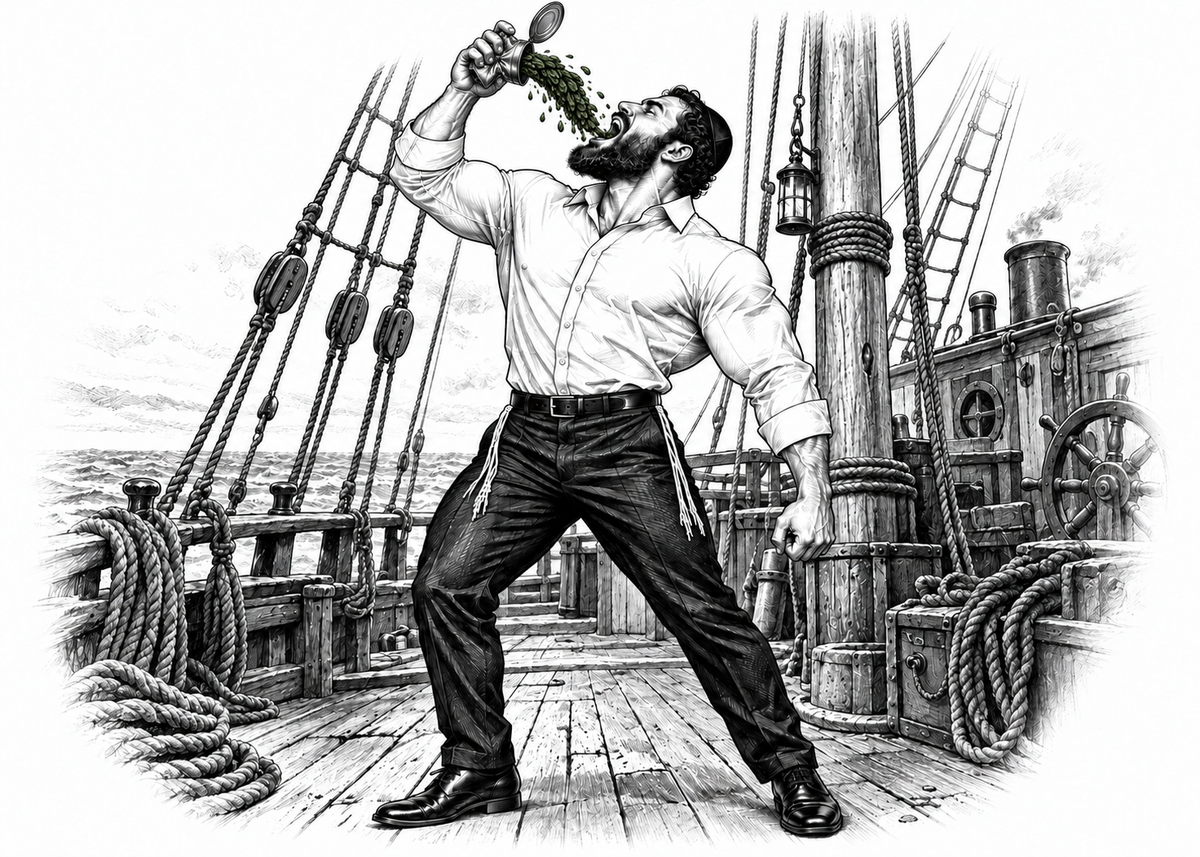
“I yam what I yam, and that’s all what I yam.” Sometimes the old lines hit the hardest. Now let me pop open this can of spinach I call a dvar Torah and start swinging. Mostly at myself, but you can come along for the ride.
But there is something so comforting in that line. Some would say it’s good for me to be okay with what I am. And there is truth to that. There have been many times when I would carry the angst and despair of trying to change, but it didn’t go right.
Saying I am what I am can be a comfort. It is a recognition and a surrender. It is saying, “This is all I’ll ever be. Don’t bother trying.” There is a time to take comfort in the man I am. To be overwhelmed with gratitude for what I have been given. But I can’t surrender everything to the man I am now. There needs to be room for growth. The biggest gadol leaves room for growth. If you said R’ Chaim Kanievsky was perfect and had nothing left to work on, that would be apikorsus, a complete sheker.
Growth is what makes us humans holy. Malachim don’t change. But me? I can change. So let’s place the self-help psychobabble happy talk on the back burner for a minute and talk about changing. About being better. Because I’ve tried to change and grow so many times before. And it didn’t take. Plans to finish Shas, get up for Tikkun Chatzos, become a dayan, become a hotshot nursing home operator, and even play jazz like a Jewish Miles Davis, all gone with the wind… maybe… there is still time…
I wouldn’t say I’ve never changed. There was a time I was too embarrassed to publish these divrei Torah, and now I am publishing my musings with impunity. I know I can change. I know I have it in me, but so many times it didn’t stick. It’s easy to take all the false starts and failures to launch and craft an identity out of them.
But this is not what a Yid is about. My rebbe, Rabbi Berkovits, would say that Jews have been called all manner of invective over the millennia. We control the banks and Hollywood, and also we are the worst vermin and villains. What we’ve never been called is mediocre. Mediocrity is the furthest thing anyone thinks of when they think of the Jews.
Mediocre means I settled. It means I surrendered to the entropy of my life and allowed myself to coast through the vastness of space with nary an ounce of friction to counterbalance my trajectory. It is the path of least resistance. It is easy. And as I get older, easier is, well… easier.
But it is not my essence. It is not what I am. I am never going to be truly happy with a blasé life. I need to change. But how?
Hashem created the world. He created light and dark. The pasuk in Yeshayahu that we read every day is interesting, and the Kedushas Levi zeroes in on this: יוֹצֵר אוֹר וּבוֹרֵא חֹשֶׁךְ, “Who forms light and creates darkness.” It’s written in the present tense. He teaches us that Hashem did not just create the world, but He is always creating. It is constantly in a state of creation.
The issue is when I view myself as a finished, fully formed being. If I see myself as already having been formed, this is my ego. Like most of self-help, it is the focus on the self. This is יֵשׁוּת, the sense that I am a separate, self-contained thing. I become attached to the physical self I already know, the settled being I have become. It doesn’t allow me to see the ongoing work of creation that I am. And perhaps this frozen, solid form can change, but that seems too much like a monumental feat. But if I view myself as constantly being in a state of creation, where every moment Hashem gives me is a truly new moment, I can connect to the אַיִן, the hidden Divine source beyond nature: the truth that I am nothing without Hashem and that He is constantly energizing me and guiding me to a new existence.
So this is sweet. It’s a nice thought. And also completely useless to me. Sometimes a good vort gives me a kernel of wisdom I want to plant and nurture into something that I can take with me, but I can’t take this one. Not yet.
It’s nice to know that everything is new, that every moment is a chance for a fresh new start. Yet I still wake up each morning with the same habits and the same notion of who I am. I carry this lifelong identity on my back like those ridiculous steamer trunks kids used to bring to sleepaway camp growing up, until their parents realized that duffel bags had been invented.
If I am being created anew each moment, why do I still feel like me? Where’s this new me that I could be?
The reality is that both parts of me are true. There is my history, and then there is the new existence, and these take up the same space. They are both happening at the same time. This is why there is a healthy way to accept what I have become, what I am now, while at the same time realizing there is more I can be. I may not be completely cut off from this identity I have crafted for myself, but I don’t need to let the man I was yesterday make all the decisions for me today.
Reb Levi Yitzchak continues in the Torah and explains that יֵשׁ is the revealed world governed by nature, while אַיִן is beyond nature. The אַיִן is not just another spiritual realm. It is the Divine source of everything. Torah and mitzvos connect the יֵשׁ to the אַיִן. My יֵשׁ is the hardened form I have made, while the אַיִן is the Divine source from which Hashem gives that form new חַיּוּת every moment. When I do a mitzvah or learn Torah, I connect the יֵשׁ to the אַיִן. That connection allows what was formed and solidified to warm up a bit, to evolve, to change. The danger is when the יֵשׁ exists on its own. When I settle for what “I yam,” I am stuck in this physical realm.
The pasuk in Yechezkel says, וְהַחַיּוֹת רָצוֹא וָשׁוֹב כְּמַרְאֵה הַבָּזָק, “The living creatures ran and returned, like the appearance of lightning.” רָצוֹא, the running toward, is taking the יֵשׁ, the hardened form of what I am, and schlepping it to the אַיִן with a mitzvah or the Torah I engage with. And then the וָשׁוֹב, the returning. I carry that connection back into the same life and the same self. The אַיִן flows back into the יֵשׁ, warming the hardened form and giving it new חַיּוּת. I am still me. I return to the same life carrying the same history. But I’m also different. I’m new.
That is all. That is the goal, the process of creation. The change. The forming anew. I can’t do this without Hashem. He provides me with this new existence every moment.
“I yam what I yam, and Hashem is still creating what I can become.”
Every beginning, every new moment, I can become light.