Yisro: Frozen Men Don’t Build
The Danger of Playing It Safe
There is no such thing as staying the same.
That sounds obvious until you really sit with it.
Until you apply it to a man who is “doing fine.”
You get married. Start working. Learn a little. Daven.
Doing the things. Not embarrassing yourself.
Never rocking the boat.
You think you’ve got it handled.
But life does not allow neutrality.
Muscles that are not used weaken.
Water that does not move turns foul.
A fire that is not fed goes out.
It is simple physics.
It doesn’t matter if you are rich or poor.
I’m sorry, but you can’t change the laws of physics.
“Kedoshim tihyu.” You shall be holy.
Tihyu, to be constantly moving and not something you set and forget.
It’s a state of becoming.
The Noam Elimelech writes that kedusha is not something static.
A Yid cannot remain on one level.
Every day there is either movement upward or a quiet slide downward.
There is no standing still.
A Jew cannot rest on his haunches.
Standing still is already decay.
Most men do not fall because they choose evil.
They fall because they stop moving.
And sadly, our current culture trains them to.
Any large system has to.
You cannot organize communities, schools, yeshivos, or families without teaching people to stay in line.
To keep your head down.
Do not stand out.
Do not make waves.
This instinct is human.
It is how groups survive.
It keeps things orderly and predictable.
But what keeps a system stable can keep a man small.
Men age into routine.
Marriage settles them.
Responsibility presses in.
In yeshiva it happens early.
The unwritten rule is learned fast.
Don’t step out of line.
Don’t ask for more than what’s given.
Don’t be the guy who disrupts the rhythm.
And over time, this survival instinct gets hailed as virtue.
You tell yourself, “As long as I’m not rocking the boat, I’m fine ”.
“This is just who I am.”
“At my stage, change is unrealistic.”
You may think these are statements of humility.
No.
They are statements of surrender.
Parshas Yisro is not about a man who heard miracles and got impressed.
Everyone heard about the miracles.
The sea splitting was not a secret.
What woke Yisro was something else.
He saw men move.
He saw Yidden step forward into the sea.
He saw mesiras nefesh before the resolution.
And then he saw Amalek.
Amalek was not just a military threat.
Amalek was a spiritual battle to cool you down and to keep you in line.
To take a people who had just leaped into the impossible and whisper, “Settle down, calm down, come back to earth; you aren’t better or different than anyone else.”
So how was Amalek fought?
By clever tactics alone?
No.
Moshe stood on the hill with his hands raised, reaching, always reaching.
When his hands fell, the people fell.
When his hands rose, they rose.
That posture matters.
Upward orientation.
A refusal to let the eye settle at ground level.
The war was won because Moshe and Klal Yisroel would not stop reaching for something higher.
Yisro saw both moments together.
A people who move first.
A people who fight cooling by lifting their gaze.
A people who understand that battle is inevitable, but stagnation is deadly.
That is when he says, “Now I know.”
Every few years a new organization appears.
A movement.
A project.
It promises to fix what has grown stagnant.
It names real problems.
It makes noise.
It calls out the rot.
It speaks disruption fluently.
And then time passes.
The laws of the universe reassert themselves.
The second law of thermodynamics is not impressed by good intentions.
All systems tend toward equilibrium.
Without constant energy, motion decays into sameness.
Entropy is not a moral failure. It is a law of nature.
Eventually, the movement becomes indistinguishable from every other movement.
Safe and manageable, it becomes another tale.
“It is a tale told by an idiot, full of sound and fury, signifying nothing.”
Unless something rises above nature, it is bound by nature.
Stagnant water breeds disease.
Families and communities absorb stillness.
We learn quickly what is permitted and what is dangerous.
They learn when not to move.
And that is precisely the tragedy.
You can destroy a world by doing nothing at all.
I know this because I lived it.
For years.
I had this newsletter inside me that needed to move. The Gibor concept sat and fermented in me.
It was an idea that waited.
A voice that I made stay quiet.
A sense of calling, but I told myself I wasn’t ready.
I waited to be good enough.
Waited to be allowed.
Waited for clarity.
And while I waited, my soul atrophied.
Starting again was brutal. It still is brutal.
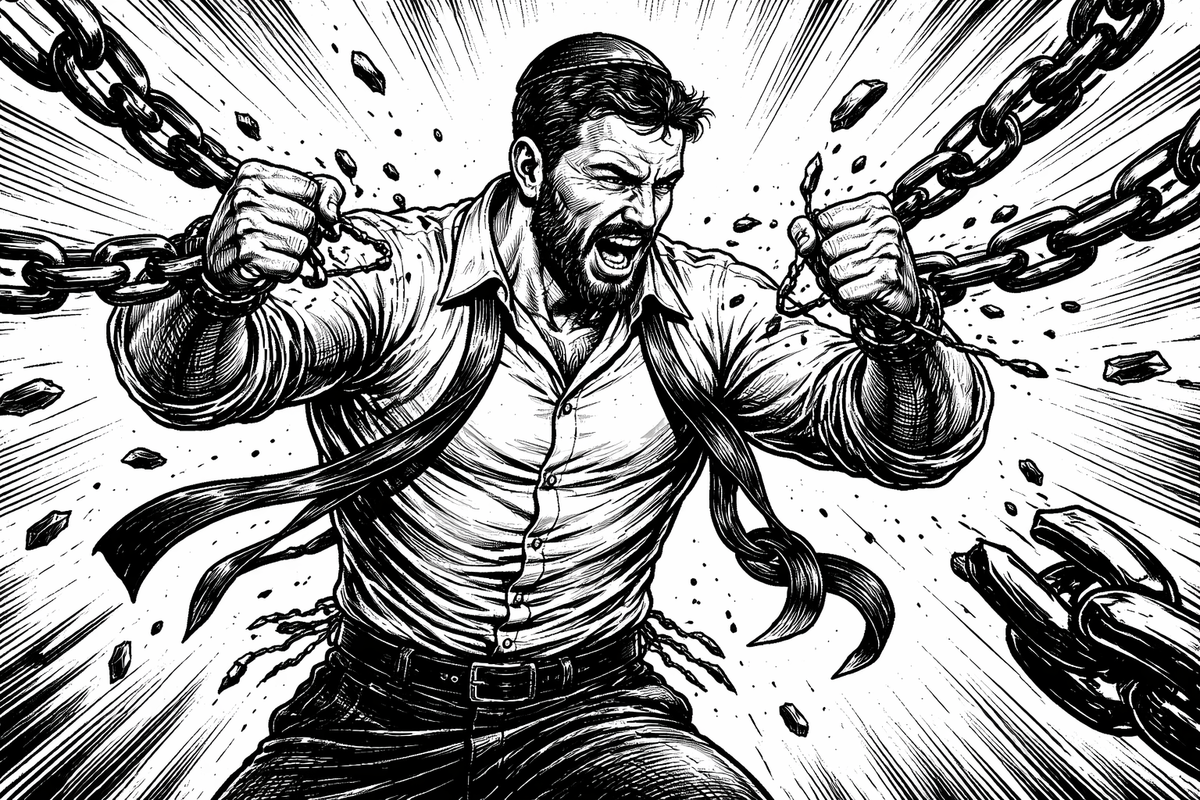
I am still writing in these chains I placed on myself, trying to break free.
Trying new things.
Stopping and starting again.
Movement after long stillness hurts.
It draws attention.
It invites resistance.
People will try to stop you, not because they hate you, but because your motion threatens their equilibrium.
Your movement exposes their rest.
But there is a point where you see the truth and cannot unsee it.
Once you see that life only exists in motion, you cannot pretend that keeping your head down is righteousness.
Planning has its place.
Thinking has its place.
But waiting forever is death.
Move.
Just move.
A little.
In any direction you can.
Start with the embarrassingly small thing you’ve been avoiding because it doesn’t feel like enough, but it is something you know you can do.
Keep that moving.
Let it grow.
Don’t wait to feel ready.
Don’t wait to be understood.
And whatever you do,
don’t stop.