Vayechi: You Were Not Meant to Make It Here
Why the End Was Hidden, and Why Galus Can Never Be the Goal
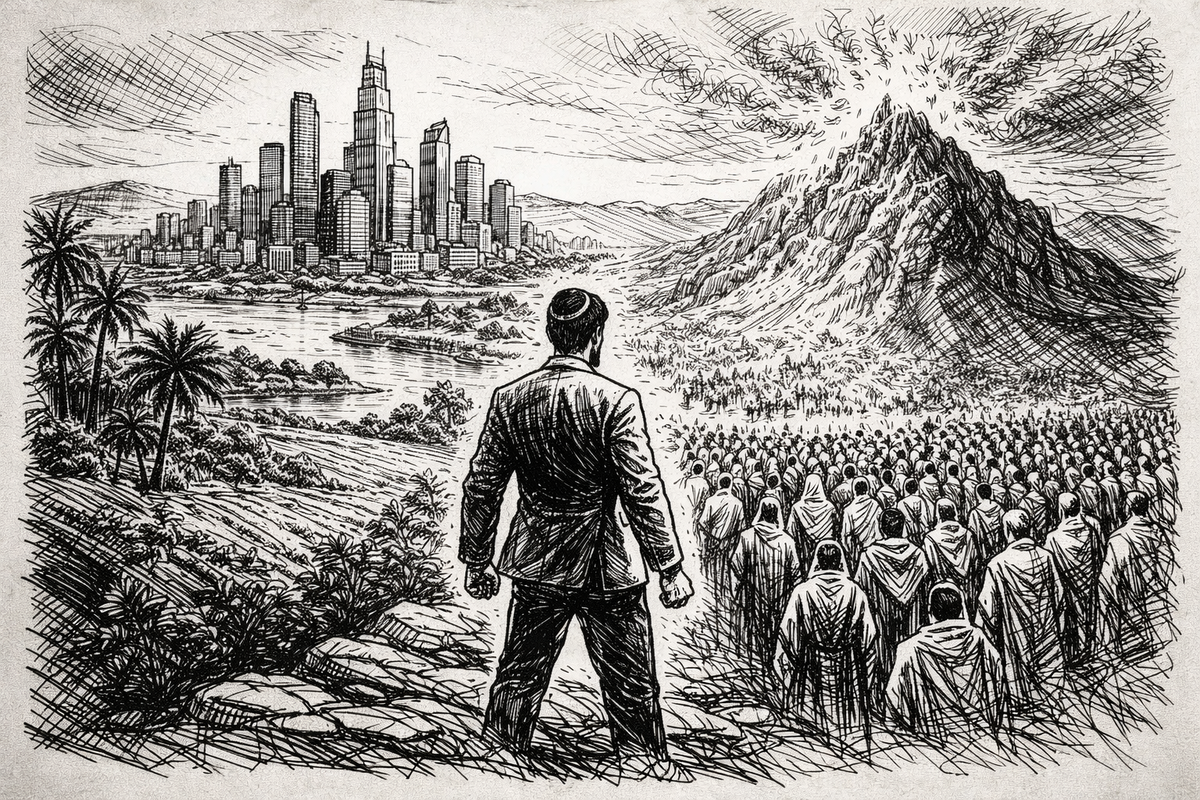
Yaakov gathers his sons for the first time in years.
All of them. Whole.
This is the moment every family waits for, what every father wants.
To see his family at peace and united.
The famine is behind them.
Yosef is alive and powerful.
The brothers are fed. They have land. They have status.
They’ve made it.
And then something strange happens.
Yaakov prepares to tell them how it all ends, but the vision is hidden.
The End of Days is taken from him.
He also makes Yosef swear an oath that borders on obsession.
Do not bury me in Mitzrayim.
The Torah places these two moments side by side for a reason.
The danger of exile is not suffering in and of itself.
It’s the complacency found there when we adapt.
Mitzrayim was a civilization.
It was sophisticated and bright and ordered.
You could rise there. Thrive there.
You could build a respectable life there. Even a religious one.
Especially a religious one.
And that’s precisely why Yaakov draws a line.
Graves create narratives.
If Yaakov is buried in Egypt, Egypt defines them.
Memory carved into destiny.
So he refuses.
Because Galus must never be crowned at home.
That same tension runs through the story of Ephraim, Yosef’s son raised in Shtufei Zima.
Ephraim is born in Mitzrayim.
He speaks its language.
He moves easily inside its systems.
He succeeds within it.
It's brought down that fell.
It brought him down; he fell to the depths of Mitzri culture.
And then he pulls back.
He does teshuva from being too comfortable.
That is perhaps another reason why Yaakov crosses his hands and gives Ephraim the greater blessing.
Ephraim may have fallen.
But he knew when to extract himself.
That is the prototype.
Resistance to being named by Galus.
Why was the End withheld?
Because messianic knowledge, given to men who are comfortable in exile, produces waiting and complacency.
It turns builders into spectators.
It trains capable men to outsource their responsibility to Heaven.
When Hashem hides the End, the Keitz. It is not as a punishment.
The hidden End demands something harder.
It demands daily discipline, accountability, responsibility, and living as if Geulah, redemption, depends on whether you are strong enough to carry it.
Picture a frum man in 2026.
He wakes up early. Minyan. Commute. Has a respectable job.
His kids are in good schools.
His house is calm.
His life works.
He keeps the Torah.
He avoids scandal.
He gives tzedakah.
He’s grateful.
And slowly he crowns that achievement as the goal.
He no longer feels urgency.
He tells himself, I didn’t assimilate. I stayed frum. And I did my job.
All is good.
And that’s the sharper danger.
Because a frum life built entirely to function inside galus can still crown galus as the goal, just with cleaner clothes, better language, and more sophisticated excuses.
The sad truth is no one lives the perfect life in galus.
The guy above is lying. To you, to himself.
He believes the lie. He told himself he is perfect; he’s toed the party line.
And this makes him more lost than the guy who is open about his struggle.
Yaakov sees this coming.
That’s why he refuses burial in Mitzrayim.
That’s why the End is hidden.
That’s why Ephraim matters.
Galus rewards competence and, at the same time, erodes identity.
Our effort to adapt and conform and make it all smoooth does’t make us unique.
It makes us like every other “ism,” pretending that utopia is in hand as long as we erase ourselves.
So you follow the rules and keep your head down.
And the galaxy of Ohr that lives inside you and in every Yid, no matter what their Chitzonius looks like, is tamped down, controlled, and imprisoned.
Like the bluebird in that poem.
This is what happens when you pretend to “know” the End.
Or if others deign to demand how the end should play out.
The end wasn’t hidden so you could wait for redemption.
It was hidden so you could become worthy of it.