Va’eira: Warm Blood
When Life Works Too Well to Need God
Pharaoh wasn’t an idiot.
When Pharaoh says, “Who is Hashem that I should listen to Him?” He wasn’t being a foolish, petulant child.
He wasn’t ignorant.
You just need to understand how Mitzrayim worked.
The Nile rose on time.
The economy ran smoothly.
Food appeared.
Power felt stable.
Life worked.
Nu? Sound familiar?
When was the last time you tilled a field or drew water from a well?
When life works, Hashem starts to feel optional.
This is something more fatal than mere rebellion.
At least rebellion still burns.
Aveirah humiliates a man, but it keeps him awake, feverish, and sweating, but awake.
There is motion and movement.
Atoms colliding as it creates friction.
Comfort does the opposite.
Comfort anesthetizes.
Pharaoh doesn’t even rage against Moshe at this point.
He just shrugs him off.
Tells him to go take his signs elsewhere.
He says, “Don’t bother us now; we’re busy running civilization.”
You can’t scare a man like that.
I don’t mean that in a good way; he’s just stone cold.
Indifference doesn’t listen.
So Hashem doesn’t debate Pharaoh.
He changes the temperature.
Water is cold.
Blood is warm.
Water represents a world that sustains life, but it can flow without intimacy.
You drink it and move on.
It is a river that is always just there.
But Blood….
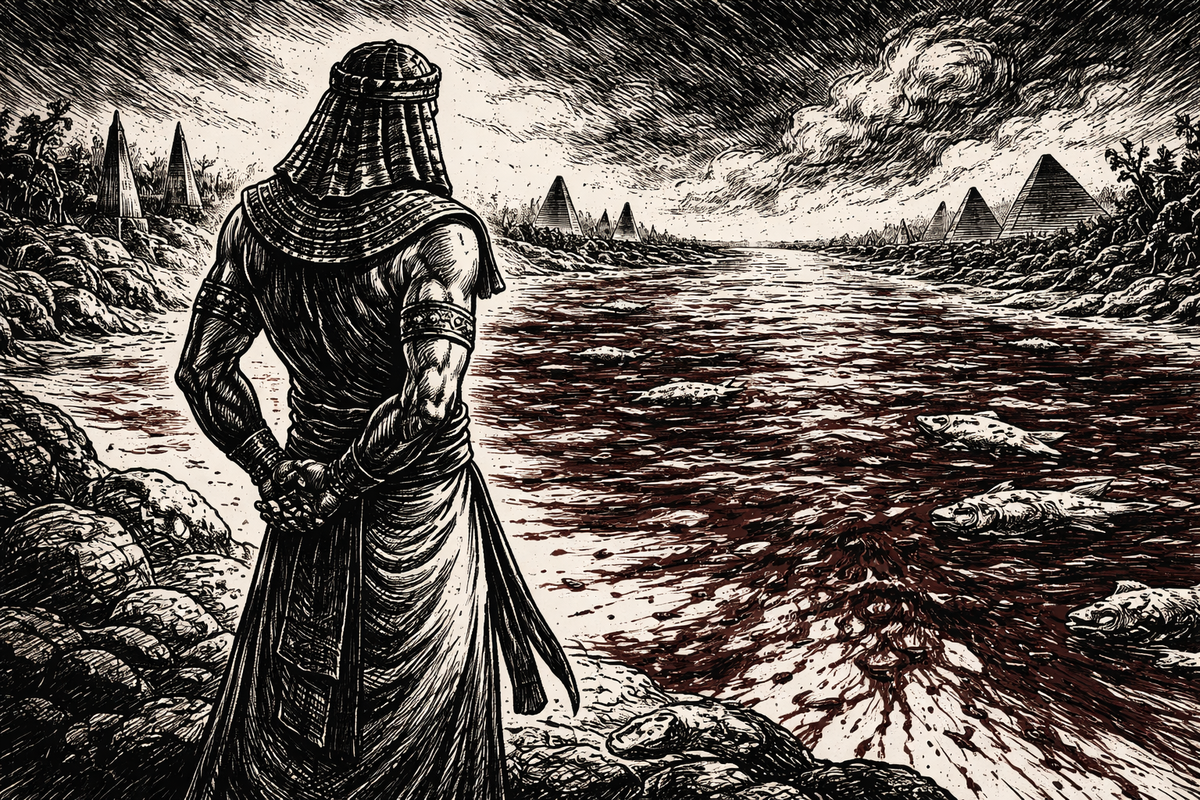
Blood is life. Blood is warmth. Blood boils. Blood stains. Blood smells. The river stank.
Their god. Their river that was always there, their source of life.
Pharaoh’s god was more than the Nile itself.
It allowed him to believe that he didn’t need anything else.
That belief made him cold towards holiness.
It is comfort without gratitude.
So Hashem strikes the illusion down.
He says, “Your god bleeds, and what once felt clean now feels intimate in the worst possible way. You can’t drink without thinking about life and death. You can’t pretend anymore.”
The Egyptians drink blood.
Bnei Yisrael drinks water.
Same river.
Vastly different reality.
But of course Pharaoh knows now. He just won’t bow.
And so the rest of the Makkos unfold.
But this is why Blood is first.
Bowing would mean allowing warmth toward Hashem.
Pharaoh can’t do that.
His heart becomes stiff.
Chassidus teaches us that we all have a little Pharaoh in our heart.
So we all have this tendency.
We need to break out of it. We need to warm up, like a frostbitten limb in the cold.
Because you aint’t going nowhere…
Coldness toward Hashem has to break first.
No miracle, argument, self-help strategy, self-care, or morning routine raindance nonsense will penetrate indifference.
You can’t build a fire on ice.
(Well, technically you can, but you know what I mean.)
Dahm, blood, is first because warmth comes first.
I know this pharaoh in my heart well.
He shows up when I’m good.
When I’m functioning.
When the family and community seem fine.
He’s the voice that says, “Relax. Stay in your lane. Don’t rock the boat. It’s working, so you… keep working.”
Like a mindless zombie, shuffling from one thing to the next.
You know the famous joke that isn’t a joke at all.
A man circling for a parking spot, promising Hashem he’ll learn, give tzedakah, do teshuvah, and be a perfect yid.
Then a space opens.
He smiles and says, “Never mind. I don’t need you. A spot opened up.”
That’s Egypt. Even the gods are God-free.
At least Aveirah wrestles you to the ground and drags you into the mud, where you might cry out.
Comfort lets you build a house there in the toxic dump, and you think it’s normal.
In Eretz Yisrael, we never had a river to rely on.
It was only ever the rain.
Which had no sense of consistency.
You can’t rely on the rain.
We had no choice but to rely on Hashem.
That’s how we stay alive, with a heart of flesh, not a heart of stone.
The first avodah of a Gibor is to distrust what feels automatic.
I beg you to invite discomfort.
In these weeks of Shovavim, the Nesivos Shalom demands you extend yourself in Torah and Tefilah.
Refuse numbness.
When something “just works,” ask why.
Ask yourself, “Am I too comfortable with the way things are?”
And if we won’t let the water warm on our own, history has shown that life will do it for us.
Better to feel the heat now than bleed later.