Tzav: All Night It Burns
What you delayed cleaning out is spreading

Print Version:
You know it’s there.
Not all the time.
During the day, you can outrun it.
There’s enough noise.
Enough demands on your attention pulling at you so you don’t have to sit still long enough to notice.
But then it gets quiet.
A few seconds longer than you meant to stay alone with yourself.
And it comes back.
No dramatic fanfare or nothing.
Just there.
A thought you’ve seen before.
Something in you that doesn’t feel clean but also doesn’t feel urgent enough to deal with.
So you don’t.
You step around it, like something left on the floor you’ve learned not to trip over.
You’ve lived with it this long.
Nothing’s collapsed.
You’re still showing up, still working, still building something that looks, from the outside, solid.
And yeah… if you slow down enough… your wife probably deserves better.
Your kids too.
You know that.
But it’s not enough to force a confrontation.
So you let it sit.
You don’t say this part out loud, but you’ve made a decision.
This part of you?
Not urgent.
The Torah doesn’t leave room for that category.
כָּל שְׂאֹר וְכָל חָמֵץ לֹא תֹאכְלוּ.
Even the smallest trace.
Why?
Because things don’t sit where you leave them.
They don’t wait.
They fester.
And what you’ve been leaving inside yourself, refusing to address, isn’t waiting.
It’s spreading.
The Torah introduces the korban in our parsha with a push.
צַו אֶת אַהֲרֹן וְאֶת בָּנָיו. Rashi says, “אין צו אלא לשון זריזות מיד ולדורות… ביותר צריך הכתוב לזרז במקום שיש בו חסרון כיס.”
Tzav means urgency, for generations.
And urgency is needed most where there is potential for monetary loss, and one would normally hesitate.
We read that and think money, that when you need to give, you do it right away; otherwise, you may neglect it.
But the Nesivos Shalom takes it deeper.
There is a חסרון כיס of the soul.
The cost of giving something up inside yourself, a hidden thing, the version of yourself you’re still protecting.
Because this korban is the עולה.
It burns completely.
And Chazal associate it with what never made it into action, your inner machshavos, thoughts, the unseen life of a person.
The Nesivos Shalom calls the inner machshavos ra’os a disease.
A crumb of bread is nothing.
A trace of infection is everything.
Disease doesn’t stay contained because you decided it should.
It just spreads.
That’s why chametz is אסור אפילו במשהו, because it won’t remain small.
Chametz isn’t just what you eat.
The Sfas Emes explains that chametz represents something swelling inside a person.
The expansion of the self beyond its proper boundaries.
It’s a subtle inflation, a place where the inner world has grown out of proportion, out of truth.
And that’s why bedikas chametz is done the way it is.
By contrast, matzah is flat, contained.
Chametz rises.
And the Sfas Emes is telling you.
What rises in you, what quietly expands when no one is looking, that’s what you have to find before it takes over more space than you ever meant to give it.
How do you check?
Where do you check?
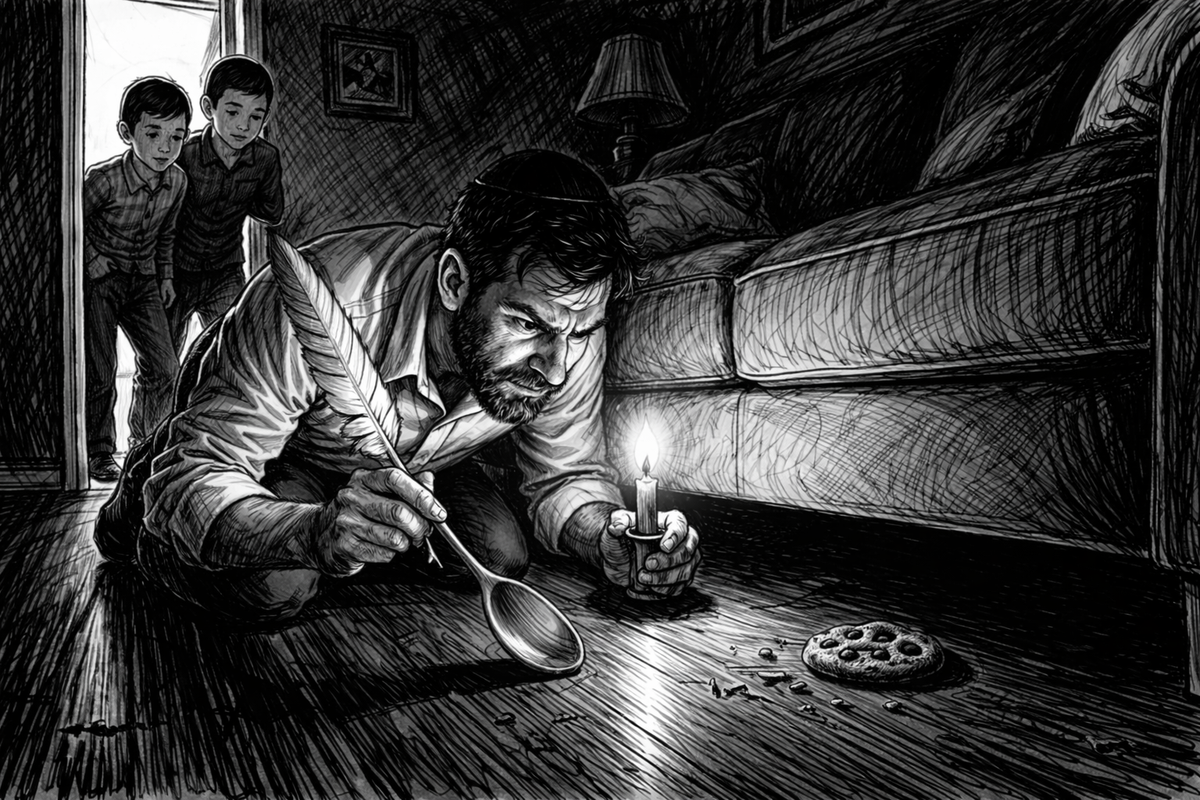
בודקין את החמץ לאור הנר.
You take a candle.
And you search חורין וסדקין, the cracks.
The places you don’t normally look.
The places no one else will ever see.
The Ramchal writes that the most dangerous failures are not the obvious ones.
It’s the subtle ones.
The ones you became comfortable with and stopped noticing.
You see, the fire on the Mizbeach doesn’t stop.
“אֵשׁ תָּמִיד תּוּקַד עַל הַמִּזְבֵּחַ לֹא תִכְבֶּה.”
Steady. Constant. All night.
Working in the dark.
The real avodah happens there, when you’re alone.
There’s a bathroom at my office.
Someone covered the walls with quotes.
Real ones, sharp ones, the kind that catch you off guard if you’re paying attention.
I’ve stood there reading them more than once.
"Do today’s work today. It won’t be any easier tomorrow."
Simple. True. Cliche even.
But standing there, I realized something I hadn’t been honest about.
That my urgency has limits.
Have I cleaned out the cracks and crevices of my heart?
My soul?
Have I done the real work?
The work no one sees, no one tracks, no one rewards?
I’m not lazy.
Most of you guys are not really lazy.
I was selective.
Driven in one direction, passive in another.
Pesach is coming.
You clean everything, all surfaces in your home.
But what about your own חורין וסדקין?
Did you check the cracks of your soul?
You can clean an entire house and leave this one place untouched.
You tell yourself, "It's small; I’ll deal with it when it becomes a problem.”
Brother, it already is.
צַו.
Move.
Now.
The Mesilas Yesharim, when he speaks about זריזות describes necessity.
A man either moves, or he decays
And he brings the words of Chazal on the pasuk, “וּשְׁמַרְתֶּם אֶת הַמַּצּוֹת”, don’t read it as matzos, but mitzvos. “מצוה הבאה לידך אל תחמיצנה.”
A mitzvah that comes to your hand, don’t let it become chametz.
Chametz doesn’t start with corruption.
It begins with delay.
You take something pure, something simple, something that could have stayed clean, and you leave it.
You give it time.
Time is what transforms it.
What was once straight becomes swollen.
Because you waited.
And that’s the part most people miss.
You think you’re buying time.
But you are not.
Leave a mitzvah sitting, leave a thought sitting, leave a part of yourself sitting, and you’re letting it turn.
For a Gibor, זריזות is not just about moving fast.
It’s about refusing to give decay a foothold.
Because delay is not neutral.
Delay feeds something.
The fire is burning.
All night.
It will either consume what doesn’t belong,
or it will consume you.
What you leave inside doesn’t stay in you, it becomes you.