Shemos: Shortness of Breath
Galus and the work of clearing the mind for geulah
By the time it happens, the man is already empty.
He’s worn thin.
He’s the kind of tired that doesn’t announce itself anymore. It just sits around the room like a guest who won’t leave.
He did what he was supposed to do today.
He held it together.
He carried responsibility like a sack slung over one shoulder. He was careful to keep hold and never put it down.
Now it’s late. The house is quiet.
The noise in his head starts to buzz because it finally has room to speak.
His body wants something.
Relief.
Escape.
Hameivin Yavin…
He tells himself he’ll only be there for a moment.
He’s not planning an extended stay in that place.
He’s just tired.
Anyone would be tired.
He’s earned this, hasn’t he?
So logical.
It’s not rebellious, it’s not a rage against the machine, it’s just the smart thing to do right now.
Right?
Nothing feels sharp anymore.
Everything feels muted.
Even guilt has gone soft around the edges.
He knows better.
He’s known better for years.
But knowledge doesn’t help when your inner world has collapsed down to a single need.
A need to quiet the pressure, to soften the noise.
This is how breaches happen.
There is no rage. No one marching against the tyranny of… what-have-you.
The breach just slips in with sagging shoulders.
It curls up in a mind that can no longer stretch past the moment it’s trapped in.
Like a cat. Like those entitled, self-absorbed, needy felines.
This is kotzer ruach.
Shortness of breath can come in a state of panic.
Often though, it comes in the slow suffocation of a man who hasn’t had space inside himself for a long time.
No room to think clearly.
No room to remember what he stands for.
No room for anything except the next small release.
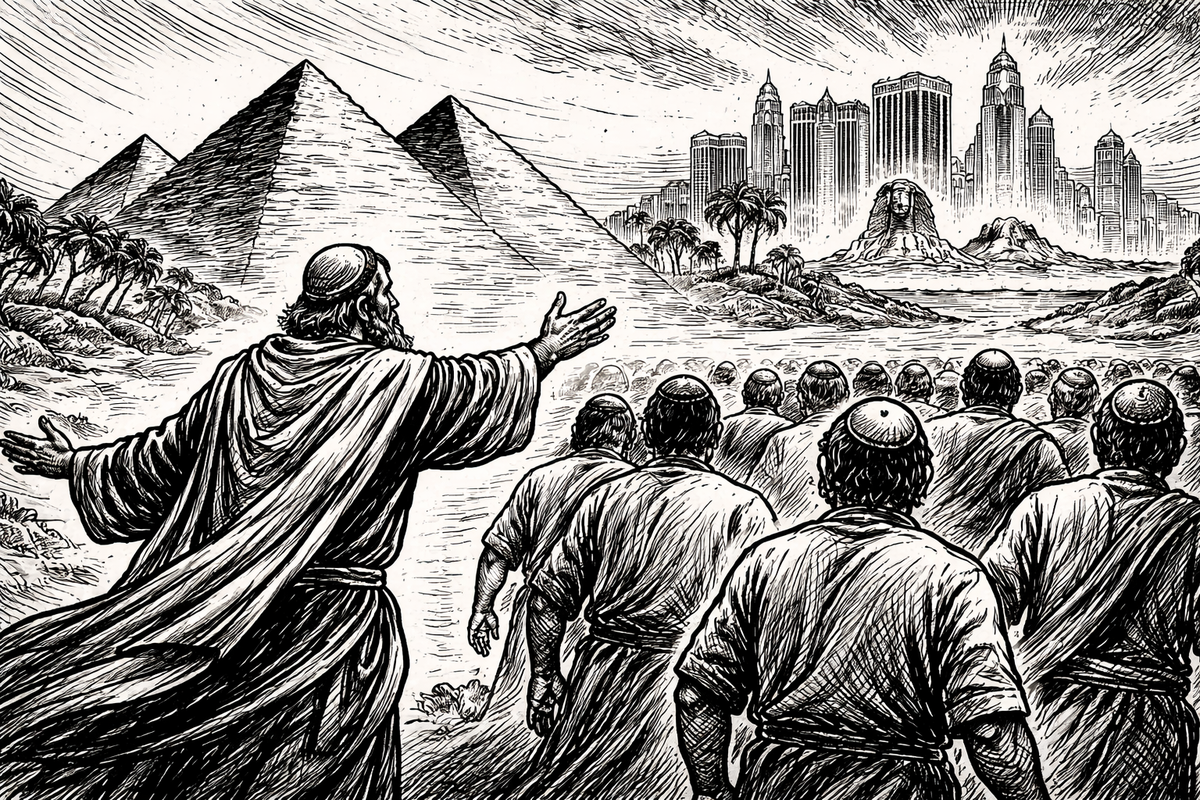
Mitzrayim.
Meitzarim.
The narrow place.
Inner compression that comes first, Hameivin Yavin…
The way desire grows louder as the soul grows smaller.
The way exhaustion trains a man to accept less from himself.
When Moshe comes with words of redemption, the people can’t hear him.
“וְלֹא שָׁמְעוּ אֶל מֹשֶׁה מִקֹּצֶר רוּחַ וּמֵעֲבֹדָה קָשָׁה.”
They don’t argue.
They simply cannot receive what he’s saying.
Their inner world is too tight.
Two hundred and ten years of pressure has done its work.
A people trained to survive cannot yet imagine freedom.
Yeah, Pharaoh is powerful, but the real Galus is in their own head.
Because their minds have been shaped by constant strain.
Galus conditions through torture and pain.
It shapes a person to fit in a space too small.
Like a rat learning to squeeze through a hole too small for itself.
Chazal describe Mitzrayim as ervas ha’aretz, a place steeped in immorality, a culture shtufei zima.
That description is often misunderstood.
It isn’t about voyeurism or decadence alone.
It’s about what happens when desire runs unchecked in an environment of oppression.
Lust becomes anesthesia.
Pleasure becomes escape.
Escape becomes a habit.
And habit slowly bends the way you see reality.
Aveiros of the flesh are rarely about appetite alone.
They are about distortion.
When desire is left without boundaries, it doesn’t stay in one corner of life.
It pulls and pulls and pulls the whole world into itself.
Like a black hole, ever hungry, ever self-destructing.
Priorities blur.
Time collapses.
Meaning thins out.
You stop thinking in long arcs and start thinking in moments.
That is its own form of slavery.
This is why redemption stalls.
You think it’s because the Yidden were unworthy?
Children of Yaakov, you who held on to your names, your language, and your way of dress?
No.
It is simply that a constricted mind cannot hold geulah.
You can remove the chains from a man’s wrists and still let Egypt live intact inside his head.
Even Moshe hesitates.
We like to frame his reluctance as humility, but the moment is heavier than that.
Moshe stands at the burning bush and resists the role repeatedly.
He sees the gap between promise and reality.
He knows what leadership will cost.
He knows the people he is being sent to.
And perhaps he feels traces of that same kotzer ruach himself.
What shifts Moshe out of that hesitation is clarity.
It’s the name “I will be what I will be.”
At a certain point, all other calculations fall away.
Just the knowledge that there is only Hashem.
When a man reaches that point, the mind can open.
Desire loses its grip.
This is the work of Shovavim.
Of clearing the inner fog.
A man who guards his inner world regains range.
He can think again.
He can hear again.
He can carry more than the moment in front of him.
Mitzrayim was saturated with immorality because immorality keeps people small.
It keeps them manageable.
You see how wide the web in the world is.
If you wanted to control the population, it’s easy.
All you need to do is feed the population porn.
And then feed them the lighter stuff that’s PG-13 but is still porn if you think about it.
Keep the people lusting, desiring.
Teach them that consumerism is the only god who listens, but he is a jealous god, a hungry god.
A man caught in that loop doesn’t need Pharaoh watching him.
He polices himself.
Geulah begins when you refuse to live permanently compressed.
When you stop using exhaustion as license.
It’s when you act even when you’re tired.
You stand still while the world spins fast.
When you do the quiet, unglamorous work of getting your own head straight.
Only then can Moshe’s voice be heard.
Only then can the breath come back.
Only then can you truly leave Mitzrayim.
Btw, I am currently giving a Shovavim shiur on Zoom every Sunday-Thursday evening at 8:45pm Central Time, for men only.
We are using the Nesivos Shalom’s Kuntreis on Shovavim.
If you’d like to join, please DM me for the link.
(You may be zocheh to hear the real me behind the snark and brimstone you read here on Substack….)