Mishpatim: The Ox Is Yours
The Blood You Pretend Not to See
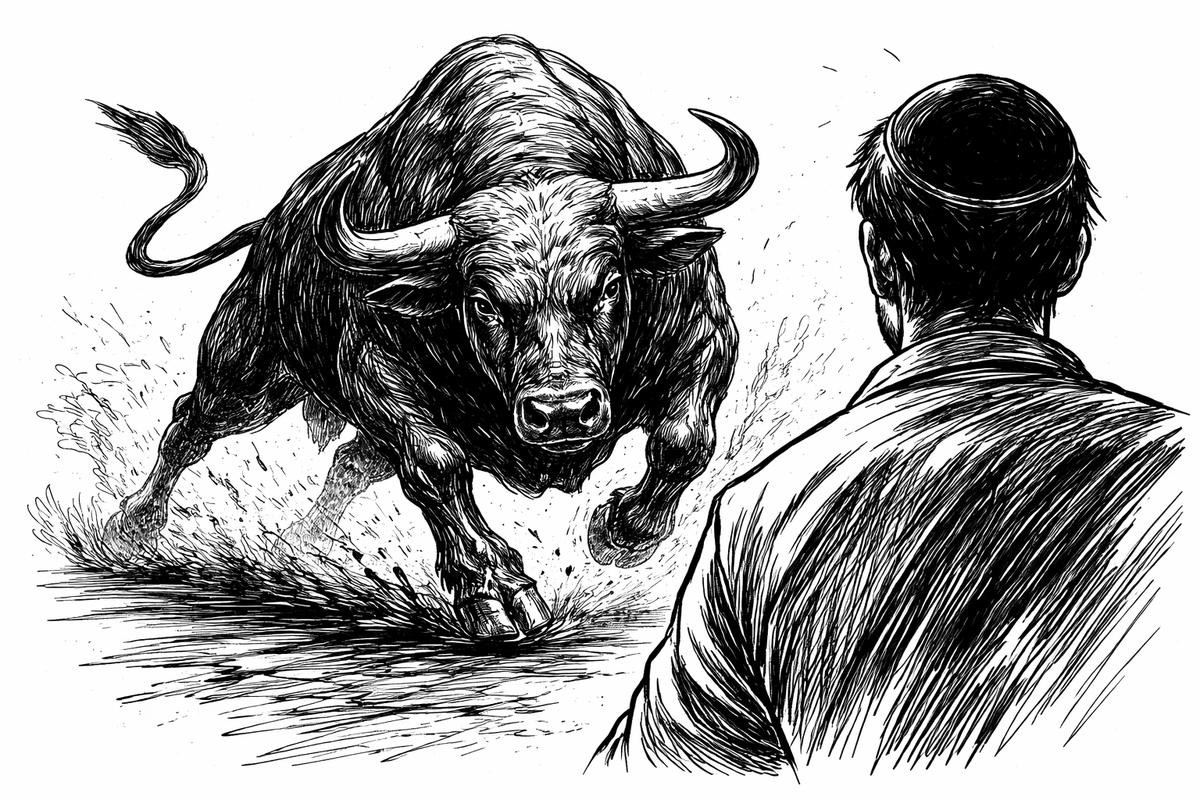
It lowers its head.
It charges.
Bone cracks.
Blood spills into dirt that was meant for crops.
It’s too late.
The horn is inside him.
The scream cut short.
Dirt and blood mix under hooves that don’t understand what they’ve done.
An ox gores.
An ox does not politely injure.
“ואלה המשפטים אשר תשים לפניהם.”
“And these are the laws that you shall place before them.”
The Torah does not begin Mishpatim with poetry.
It starts with civil law, slavery, torts, and gore.
We all just stood at Har Sinai.
Thunder and fire.
The voice of הַשֶּׁם split reality in two.
And the next thing we know, He places a dead body before us.
Because you need to know that if your ox kills, your revelation did not descend far enough.
“ואלה המשפטים אשר תשים לפניהם.”
Place them before them.
Not in heaven.
Not in theory.
Before them in the dust.
Covered in blood.
I used to think Mishpatim was just administrative.
Necessary but secondary.
The real stuff was the fire, the ecstasy.
“Lord, get me high!!!!!”
Now I’m not so sure.
Of course there is a place for all that, but its not all that.
The Ishbitzer notices something strange.
Here it doesn’t say the usual, “And Hashem spoke to Moshe.”
It says to place these laws before them, all of them. The exact same way.
Justice flattens out the status games we like to play.
When a king inspects his soldiers, even the general must stand in line.
The respected Rav.
The generous donor.
The polished professional.
The kollel yungerman with perfect dedication.
The poor man.
The socially off man.
The man who was taught to be afraid of his own shadow and to fall in line and to be “normal.”
The cool man.
The with-it man.
The well-connected man.
All must stand in line and receive the same.
There is no exemption clause for being admired or being shamed for that matter.
Sadly in our communities today we have built a status game with a frum flavor.
We compete over learning, influence, chumros, access, and philanthropy.
We measure who is “holding” and who is slipping.
It’s subtle. Sometimes, it’s… not.
We know how to hide judgment in concern.
And all the while we are calculating, someone is bleeding.
Not from an ox.
From our tone.
From our indifference.
From the way we dismiss a struggle because it does not fit our narrative of how a Yid behaves.
I recognize this because I have done it.
I still do it.
I have judged a man for being lax without knowing what it cost him to wake up that morning.
I have looked at a wealthy Jew and assumed vanity instead of seeing the weight he carries.
I have watched a Posek issue a lenient psak and felt suspicious, as if strictness were the only currency of integrity.
My ox has gored.
The Mei HaShiloach says something terrifying yet uplifting and eye-opening.
“When a man’s possessions cause damage, it reflects a lack of inner refinement. If the soul were refined, even his animals would not cause harm.”
R’ Chanina ben Dosa’s goats returned with bears on their horns.
His kedusha extended outward.
His refinement shaped reality.
So what extends outward from me, from you, when you are not careful?
Resentment does.
Resentment that others do not see how hard you are trying.
Resentment that holiness feels unevenly distributed.
Resentment that some seem to rise while others are forced to grind.
And sometimes, if I am honest, resentment toward Heaven.
“If You want me to serve You, why make it this complicated?”
The Ishbitzer calls that a grievance against God’s hidden ways.
But “keep justice”, he says.
Restrain yourself from nursing that complaint.
Because resentment leaks.
It hardens a man.
It makes him sharp with his wife, impatient with his children, and skeptical of his brothers.
It makes him judge.
“Tzedek, tzedek, tirdof.”
Pursue justice properly.
This is the source for “dan l’kaf zechus.”
Pursue a justice that does not humiliate.
The greatest poskim understand this.
I’ve always found that the bigger the Rav, the more he absorbs before he makes his ruling.
He feels the rent that is due.
He senses the shame behind the question.
He knows that halacha is not a trophy but a derech.
Small men use halacha to win.
Great men use it to carry others.
And there are many great ones.
Rabbanim who quietly bear the community’s fractures.
Wealthy Yidden who give more than we know.
Ordinary Jews with no title who instinctively assume the best about another Yid.
They teach us something we forget in our comfort.
Every Yid is a chelek Elokai mima’al.
We have in each of us the Ohr of a million suns.
If we only would just take notice.
What about for ourselves? Do we judge ourselves righteously?
Do you know what you are made of?
You are forged from light older than the stars.
Comfort is not evil, but it is dangerous.
It convinces us we have arrived.
Soldiers who believe they have arrived stop scanning the horizon.
Mishpatim drags us back into formation.
Your ox is your influence.
Your ox is your money.
Your ox is your words at the Shabbos table.
Your ox is the silent look you give another yid when you think he’s not looking.
If your ox gores, you pay.
Not only in coin.
But in the hard work of scraping resentment out of the heart.
Har Sinai was fire. Mishpatim is blood and dust.
It is IRL, brother, and it hurts and smells bad sometimes.
Holiness that does not reach the dust is just a show you put on to appease the masses.
It’s funny, because for the most part no one really cares about your little show with all your prancing about.
Everyone else has their own blood and guts to contend with.
So stand in line together.
No one is above another, and no one is disposable.
A Gibor is not the man who climbs highest in the game of status.
He is the man who refines himself so thoroughly that nothing he touches leaves another Yid bleeding.