Ki Tisa: After the Shattering
When we found out how far Hashem would go for us

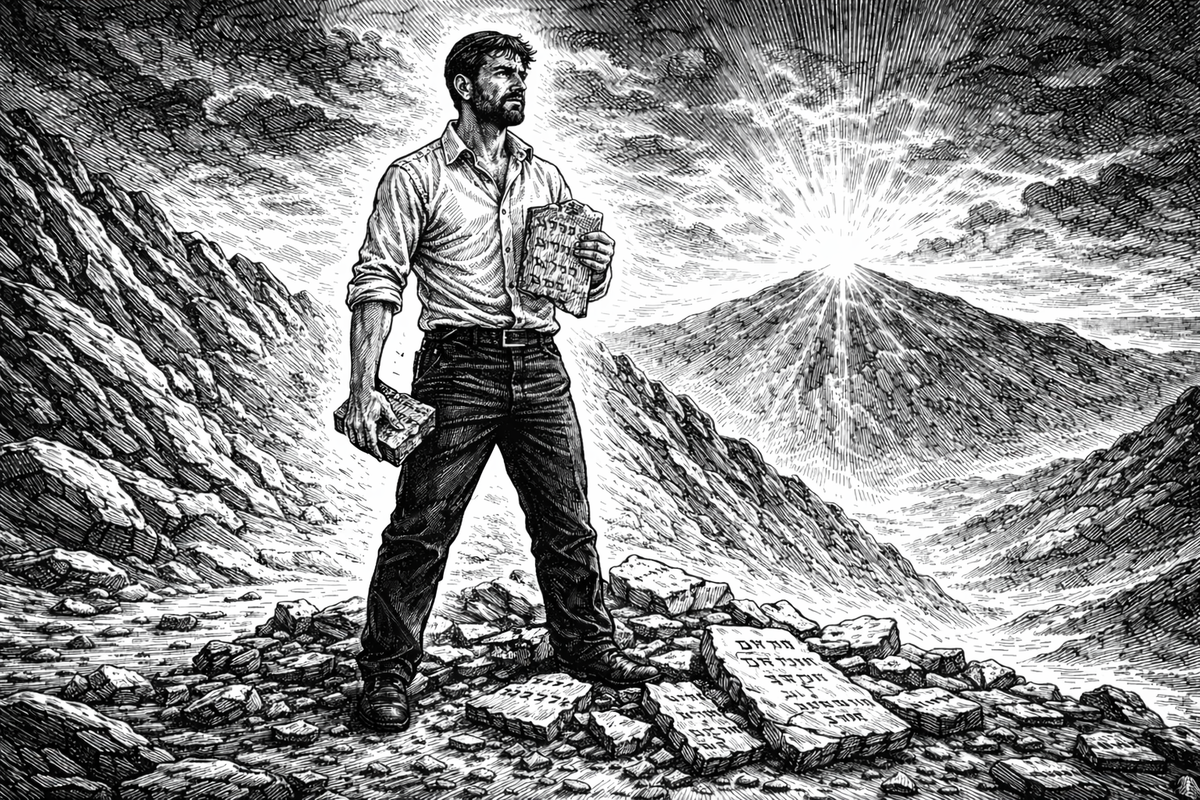
Stone explodes.
Shards everywhere.
Moshe doesn’t set the Luchos down.
He throws them.
The sound must have ripped through the desert like thunder breaking the sky open.
Two slabs of sapphire crashing into rock.
The handwriting of the Ribbono Shel Olam Himself splintering across the mountain.
Forty days earlier the entire world held its breath as a nation heard “Anochi Hashem Elokecha.”
Now the same nation is dancing around a statue.
Of gold, music, and betrayal.
A people who witnessed the fire of Har Sinai and then built an idol before the echo of the Kolos Uvrakim even faded.
If there was ever a moment the covenant should have died, it was here.
Hashem Himself says it.
וְעַתָּה הַנִּיחָה לִּי וְיִחַר־אַפִּי בָהֶם וַאֲכַלֵּם
“Now leave Me, and My anger will burn against them, and I will destroy them.”
The story, our story, should have ended right there.
Maamid Har Sinai should have become a tragic memory remembered by only one man.
A flash of glory swallowed by human weakness.
But Moshe refuses to let the story end that way.
He climbs the mountain again.
The Luchos are gone.
The nation has betrayed everything.
The Bris we had with Hashem lies shattered in the sand.
But in the wreckage, a revelation appears that never came at Sinai.
The Torah says,
וַיַּעֲבֹר ה׳ עַל־פָּנָיו
The Thirteen Attributes of Mercy.
Chazal say something so daring that the Gemara almost apologizes for saying it.
The Gemara says in Rosh Hashanah (17:), “If the pasuk had not written it, we could not say it. The Holy One wrapped Himself like a shaliach tzibur and showed Moshe the order of prayer.”
Hashem Himself teaches Moshe how to ask for mercy.
And this revelation appears only after betrayal.
Only after the Luchos shatter.
Rav Tzadok HaKohen writes that before the sin the Jewish people knew the greatness of Hashem.
Har Sinai revealed divine power.
Fire on the mountain.
A voice that shook the world.
But after the chet something deeper was revealed.
The relationship did not end.
Instead, the Torah revealed something more frightening and more beautiful.
The loyalty of Hashem to His people.
It was after the damage was done that Moshe could ask,
“הראני נא את כבודך”
“Show me Your glory.”
He asks Hashem a technical hashkafah question.
“נתאוה לעמוד על מתן שכרן של צדיקים ושלותן של רשעים"
Moshe wanted to understand the reward of the righteous and the tranquility of the wicked.
Was this really the time?
Yes.
Moshe was asking, “How can this world reflect Hashem’s honor if evil seems to win?"
If there is no way back to the light?
Hashem answers Moshe with words that shake the ground beneath the question.
“אני אעביר כל טובי על פניך.”
"I will pass My Good before you".
The Pri Tzadik focuses on two
words, כל טובי, “all My goodness.”
Not just the sweet parts.
All of it.
Even the moments that look like the opposite of good.
A perfect relationship can still easily break like a porcelain vase.
But a relationship that survives betrayal becomes something else entirely.
Unbreakable.
After the Eigel, our Bris with Hashem is no longer based only on revelation.
It is based on loyalty.
On all the “good of Hashem."
The Sfas Emes explains that the second Luchos were actually greater than the first.
The first tablets were entirely divine.
The second begin with human hands, “פסל לך שני לוחות אבנים”
"Carve for yourself two tablets of stone.”
Human effort enters the scene.
The Torah after the second tablets contains something the first did not.
The depth that comes from struggle.
But the Sfas Emes points out something else hiding in the parsha.
Right before the story of the Eigel, the Torah commands the Yidden about Shabbos. “אך את שבתתי תשמרו.”
Why here?
Because Shabbos is the weekly reminder that our relationship with Hashem will always survive.
Even when we fail, Shabbos arrives again.
The world stops.
The relationship breathes again.
Shabbos is the bond between Hashem and Bnei Yisrael that is deeper than our worst moments.
Rav Kook in his Oros HaTeshuvah wrote, "How great is teshuvah, for it elevates a person to a level higher than before the sin.”
Sometimes the fall doesn’t destroy the relationship.
Sometimes it reveals how deep it really was.
This is personal. It's real.
Because every man knows this moment.
You see flashes of the life you could be living.
The father you could become.
The husband you should be.
The spiritual fire that once felt so close.
And then you see the distance.
The gap between what is and what could be.
That realization burns.
Rebbi Akiva felt it at forty years old.
An ignorant shepherd standing at the edge of his life, suddenly realizing how much had never begun.
Most people cannot bear that kind of pain.
So they numb it.
With noise.
Distraction.
Sarcasm.
Anger.
Anything but sitting quietly with the shattered tablets of their own life.
The Torah refuses to let us look away.
The broken pieces are still there on the mountain.
But the real revelation of this parsha is not the aveirah.
And it is not even the forgiveness.
It is the moment we discover something about the relationship itself.
Har Sinai may have revealed the greatness of Hashem.
But the Eigel Hazahav revealed something greater.
It revealed how far Hashem is willing to go for us.
And somewhere in the silence after the shattering, we discovered something else.
How far we are willing to go for Him.