Eikev—The Heel and the Whole Torah
Your entire purpose lives in the thing you’re holding right now
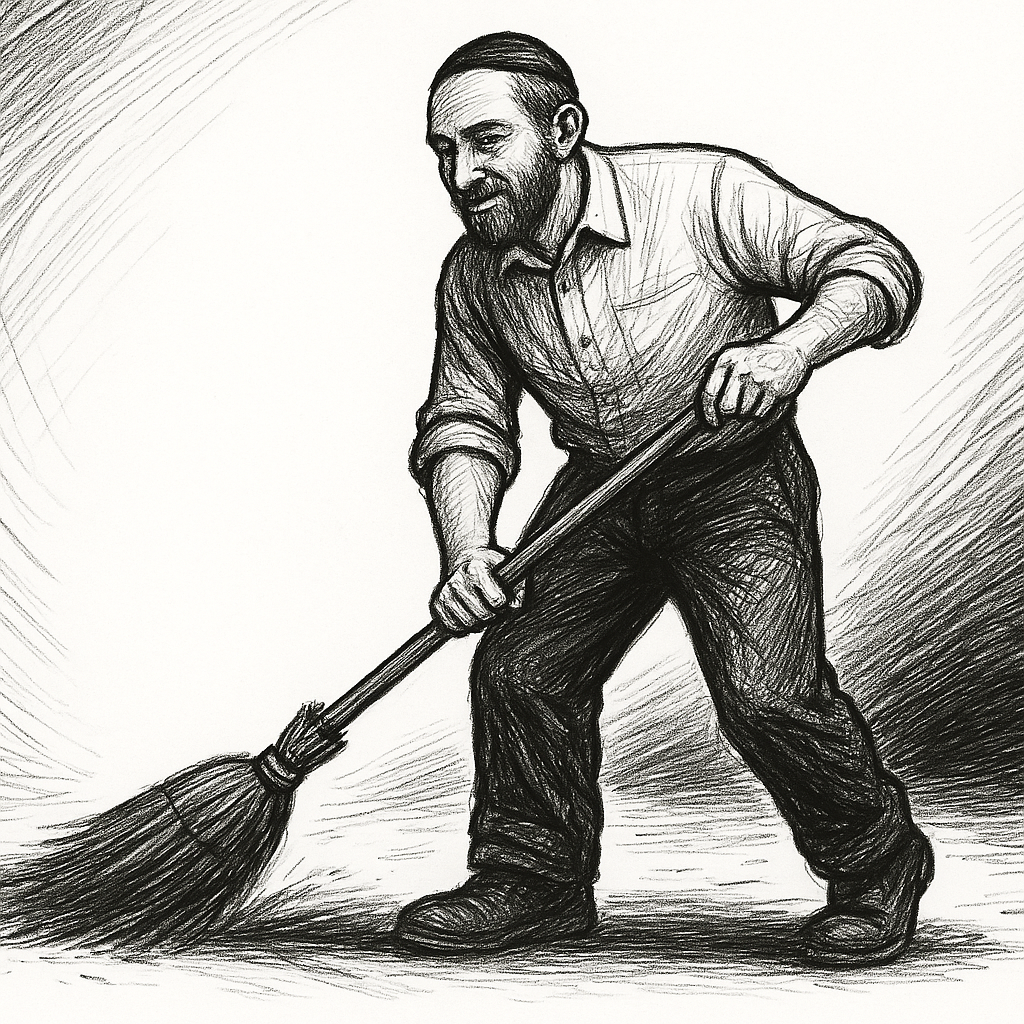
So you tighten a mezuzah, or you pick up a dropped siddur.
You put a coin in the pushka.
These things. So small, so seemingly insignificant.
Such wow.
These, you are most likely to trample.
What is small
וְהָיָ֣ה עֵקֶב תִּשְׁמְע֗וּן
Rashi famously teaches us that the word Eikev refers to the mitzvos we trample with our heels.
So he tells us we need to be careful with the small things.
Truthfully, the small things that are often trampled are not even the examples I just gave you.
Those are actually easy things.
The real small things are the things you never even gave value to.
How you speak about other Jews who are not like you.
How you speak about humans who are not like you.
When you leave the house for work, in what emotional state do you leave your kids and your wife?
How do you speak at work?
These things have no value for many on the totem pole of religious life.
So Rashi tells you to be careful.
But is that all there is to it?
See, if you read Rashi plainly, it sounds like he says the evaluation remains.
There still is small and still large.
Which means you are still going to run around this world with assumptions.
You pat yourself on the back when you put a coin in the pushka, maybe even when you say good morning to the receptionist.
And your son still thinks you have more love for your phone than him.
It's All Ratzon
Rav Moshe Feinstein teaches us that viewing mitzvos as small or large is a result of our small mindedness.
We need to put things in boxes, so we judge based on our own understanding of what is big and what is small.
But the truth is every mitzvah is a summit. The only thing small is the eye that sees it as a hill or a mountain.
All mitzvos are ratzon Hashem.
From Hashem’s perspective it’s all the same.
Rashi is telling us that the way we value mitzvos is flawed.
The Torah never measures mitzvos.
We do… and we always get the math wrong.
Life Beyond The Mind
We often don't realize that the Torah invites us to live beyond the confines of this world.
We get stuck in human structures and mechanisms.
Our long galus has robbed us of this depth.
But many tzadikin say that we can recover the lost Torah from the world.
Many cultures and philosophies have observed and incorporated some of the kernels of truth that we had lost.
We can learn from them and remind ourselves of the inheritance we lost.
I believe this concept that Rav Moshe teaches us is one such lesson.
We see it so clearly in multiple disciplines.
Let me share two such approaches with you.
Autotelism
It was first brought into modern psychology by Mihaly Csikszentmihalyi in the 1970s–80s, especially in his work on Flow.
Autotelism means the act is the reward.
You do the thing not because it leads somewhere, but because the doing itself is complete.
A soldier doesn’t polish his boots for applause, and a Jew doesn’t put on tefillin because it will someday pay off.
It may, but the payoff is not the point. That's a childish view of things.
The act is the summit.
The moment you need a future payoff to justify the mitzvah, you’ve already stepped off the mountain.
Zen
Zen taught, “When sweeping the floor, only sweep the floor.”
No thought of the next room, no weighing if this corner matters more than that one.
The entirety of the universe is in the broom, in the motion, and in the dust that rises and falls.
The moment you wonder if it’s worth doing, you’ve already left the room.
Their classic line is, “When walking, just walk. When eating, just eat.”
They taught this in the 6th century.
The Torah taught this to us well before then.
Peace
There is a peace that comes from living this way.
There’s a quiet that settles in when you stop ranking every act by its usefulness.
No ledger running in the back of your mind, no anxiety over whether you’ve chosen the “right” thing.
Each moment becomes whole.
Eating an apple is just eating an apple, not fueling for the next task.
Or learning just to learn, not worrying about how it will be used later.
And when you use it later, embrace that moment and be grateful for this one spent learning.
Life stops feeling like a staircase you’re racing up and starts feeling like solid ground under every step.
Why We Do It
Why ask “Is this important enough?” before you act?
Do the mitzvah before you as if it’s the only mitzvah in the world.
In autotelic terms, the mitzvah is the goal, not the means.
Do it because Hashem wants it. That’s the whole equation.
The mitzvah in front of you is your Mount Sinai.
There are no small mitzvos, only small hearts that measure them.