Beshalach: After the Song
The Most Dangerous Moment in a Man’s Life
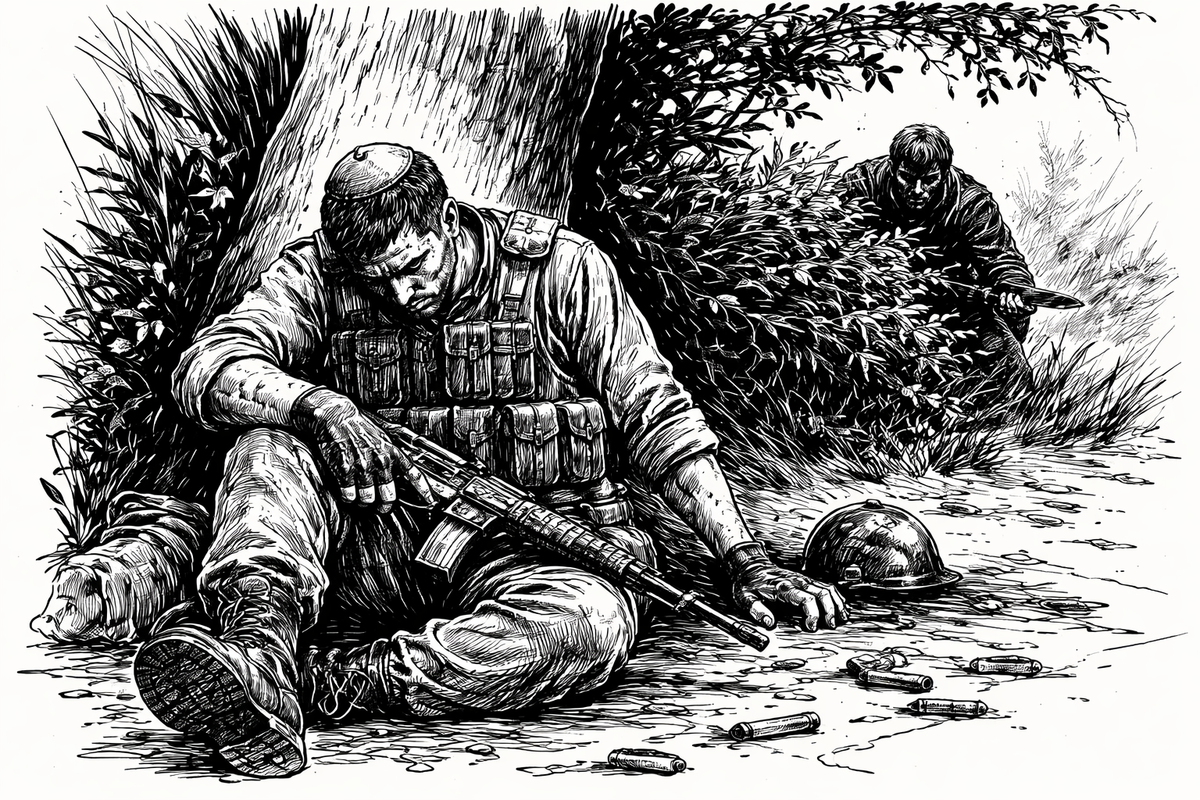
Amalek attacks after the sea splits.
When it’s calm and when we are fed.
When it’s all good and I just finished my mahn steak dinner.
The Torah places the ambush deliberately, almost offensively so, here.
Not in the midst of a crisis.
The water has just closed.
The impossible already happened.
We who were slaves yesterday watched the world crack open and obey.
We walked through the seabed like kings.
We sang.
And then, Amalek attacks.
The timing is the key here.
It is easy to assume that danger belongs only in the middle of struggle.
We brace ourselves when things are hard.
We tighten when we feel trapped.
The Torah is warning us about relief.
“אשר קרך בדרך.”
Cooling doesn’t mean outright sin.
It’s just the release of the nervous system exhaling after holding the line.
This is exactly when men drop their guard.
Look at the sequence.
After the sea comes the song.
Gratitude pours out.
But the song was a release valve, not a fortress.
The music always ends, and life resumes.
And then comes the real test.
The mahn.
Daily food, daily living, and no slavery or Pharaoh to get our haunches up.
There is no immediate danger.
But also, no control over the situation.
We are now completely at the whim of Hashem, with no way to know what will come next.
Eat today. Trust again tomorrow.
This can be harder than Egypt.
Slavery may break the body.
Bitachon confronts the ego.
Dependence without urgency can be unbearable.
There’s no enemy to fight, no adrenaline to ride.
There is no crisis to fight off or to organize around.
In that environment the complaints begin.
“What will we drink?”
“What will we eat?”
“Why did you bring us here?”
No one is drowning or starving, yet our spirit frays.
That’s the cooling.
It is not just an ancient or spiritual story.
It’s drilled into every modern army.
Soldiers are taught that the most dangerous moments of an operation are not in the breach or the firefight.
They’re the minutes and hours after the objective is secured.
After the body comes down from adrenaline and the threat seems neutralized.
That’s when men forget to clear the room again.
That’s when weapons are mishandled.
When perimeter checks get sloppy.
When friendly fire happens.
When ambushes succeed.
Your judgment softens, and reaction time slows.
Once the immediate objective is “clear,” soldiers are trained to immediately follow a strict sequence of actions rather than pausing.
This is called “The Consolidation Protocol.”
Every serious unit trains for this window.
Checklists. Protocols. Repeated drills. Perimeter security sweeps.
The Torah knew this before any military manual was written.
Imagine the following.
A man wrestles an intruder out of his home.
His hands are shaking, but his kids are safe.
He collapses onto the couch and says, “Thank God, it’s over.”
But he forgets to lock the back door.
That’s when the second man walks in.
Amalek is the second man.
So what do you do, in your moments of calm, when things subside after a crisis?
Sit back and relax?
Forget the discipline and the overall mission?
Miracles won’t protect you here.
It’s just trust.
It is the hardest thing, especially when you’ve been through the ringer and just want to veg out and be done with it all for the moment.
That’s why the Torah gives us mahn with rules.
Shabbos with limits.
Daily fixed rhythms with no improvisation.
The fall after a win is a normal human tendency.
You can train for it. And mitigate it if you are prepared.
Being surprised by it is negligence.
You already know how you behave in a crisis.
The question is, who are you when the song ends?